Building a World Where Righteousness Drives Success.
Table of Contents
- Executive Summary
- Introduction
- Methodology
- Global Rankings — Top 20
- Complete Rankings — All 135 Countries
- Regional Analysis
- Key Insights
- Limitations
- Conclusion
- Download Dataset
1. Executive Summary
The Righteous Index for Nation (RI-N) 2026 is the inaugural global assessment of national righteousness across 135 countries. RI-N measures how nations align with the principles of integrity, justice, and lawful motivation across six dimensions: Rule of Law, Anti-Corruption, Human Rights, Freedom, Public Safety, and National Responsibility.
Key Findings from the Inaugural National Righteousness Index
The Righteous Index for Nation (RI‑N) 2026 covers 135 countries across all world regions. The global average RI‑N score is 53.2 (on a 0–100 scale), placing the typical country in the “Developing” category. Scores range from a high of 85.0 (Denmark) to a low of 17.9 (Haiti), with a standard deviation of 15.8, indicating substantial variation in national righteousness performance worldwide.
Global Statistics at a Glance
| Metric | Value |
|---|---|
| Countries covered | 135 |
| Global average | 53.2 |
| Standard deviation | 15.8 |
| Highest score | 85.0 (Denmark) |
| Lowest score | 17.9 (Haiti) |
| Median score | 51.3 (India) |
| Above‑average countries | 62 |
| Below‑average countries | 73 |
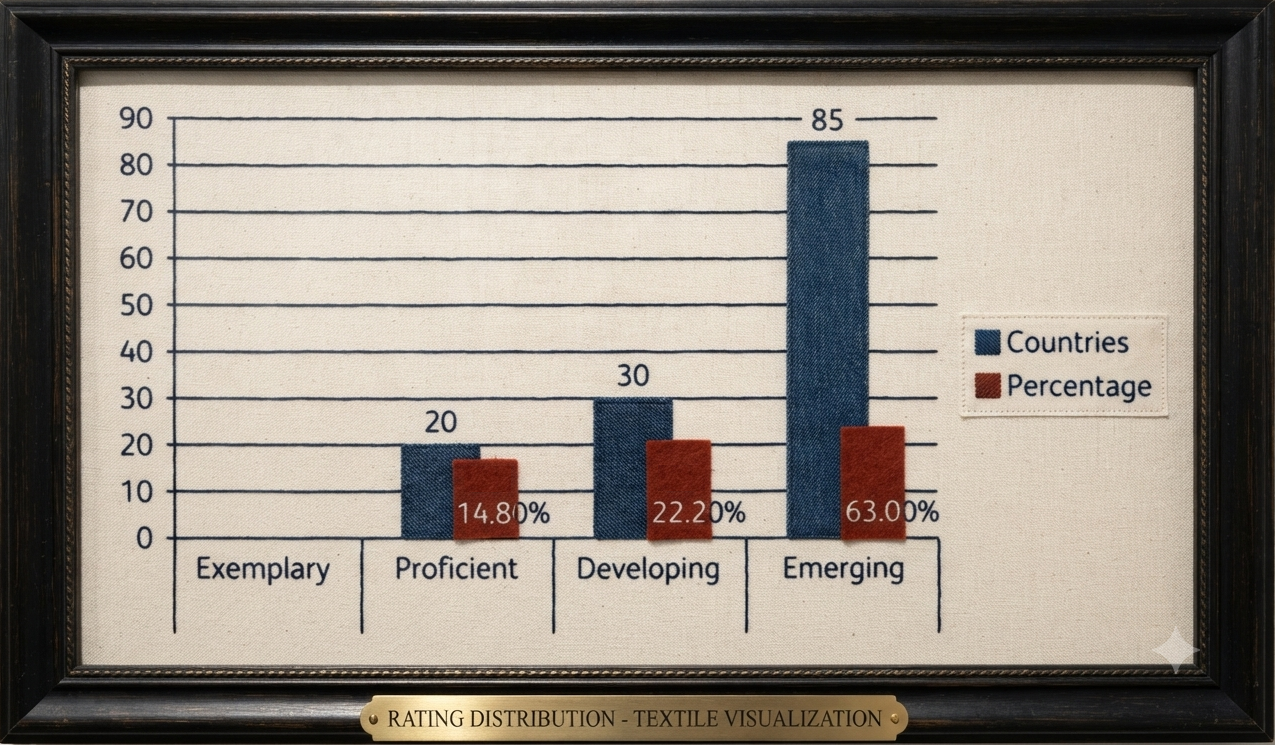
Rating Distribution
| Rating | Score Range | Countries | Percentage |
|---|---|---|---|
| Exemplary | 86 – 100 | 0 | 0.0% |
| Proficient | 71 – 85 | 20 | 14.8% |
| Developing | 51 – 70 | 30 | 22.2% |
| Emerging | 0 – 50 | 85 | 63.0% |
More than six in ten countries (63%) fall into the “Emerging” category, highlighting the scale of the challenge facing global governance, rule of law, and institutional integrity.
Score Distribution
| Score Range | Countries | Percentage |
|---|---|---|
| 80 – 100 | 6 | 4.4% |
| 70 – 79 | 14 | 10.4% |
| 60 – 69 | 12 | 8.9% |
| 50 – 59 | 17 | 12.6% |
| 40 – 49 | 38 | 28.1% |
| 30 – 39 | 28 | 20.7% |
| 20 – 29 | 13 | 9.6% |
| 0 – 19 | 7 | 5.2% |
The largest concentration of countries (28.1%) falls in the 40‑49 range, near the global average. Only 6 countries (4.4%) score 80 or above, while 7 countries (5.2%) score below 20.
Key Takeaways
- High performance is concentrated: The top 20 countries (14.8%) are all rated “Proficient” or higher, and they are overwhelmingly located in Europe, Oceania, and North America.
- A long tail of low scores: More than half of all countries scored below 50, reflecting systemic weaknesses in Rule of Law, Anti‑Corruption, and National Responsibility.
- Regional gaps are wide: The gap between the highest‑scoring region (Nordic, 82.1) and the lowest (Sub‑Saharan Africa, 42.7) is nearly 40 points, illustrating the uneven state of national righteousness worldwide.
2. Introduction
The Righteous Index for Nation (RI-N) is a composite index designed to measure how nations align with the principles of righteousness — defined as the alignment of values, actions, and lawful motivation. RI-N moves beyond traditional economic metrics such as GDP to evaluate how responsibly nations govern, treat their citizens, and contribute to global well-being.
RI-N draws on data from six internationally recognized sources:
- World Justice Project (Rule of Law)
- Transparency International (Anti-Corruption)
- V-Dem Institute (Human Rights)
- Cato Institute (Freedom)
- Numbeo (Public Safety)
- World Intellectual Foundation (National Responsibility)
3. Methodology
3.1 Dimensions and Weights
RI-N evaluates nations across six dimensions, each weighted according to its relative importance to national righteousness:
| Dimension | Weight | Data Source | Year |
|---|---|---|---|
| Rule of Law | 21% | WJP Rule of Law Index | 2025 |
| Anti-Corruption | 21% | TI CPI | 2025 |
| Human Rights | 20% | V-Dem Index | 2025 |
| Freedom | 15% | Cato Human Freedom | 2023 |
| Public Safety | 14% | Numbeo Safety Index | 2025 |
| National Responsibility | 9% | WIF RNI | 2026 |
Note:The dimension weights were established through a multi-stage expert consensus process. Initial weights were assigned based on the “foundation-first” principle, then averaged across four independent expert sources (Righteous Advisory, ChatGPT, Gemini, and Copilot). The final weights were reviewed and approved by the Righteous Advisory founding team to
ensure alignment with the RSS framework.
3.2 Calculation Formula
RI-N Score = (Rule of Law × 0.21) + (Anti-Corruption × 0.21) + (Human Rights × 0.20) + (Freedom × 0.15) + (Public Safety × 0.14) + (National Responsibility × 0.09)3.3 Rating Scale
| Score Range | Rating |
|---|---|
| 86 – 100 | Exemplary |
| 71 – 85 | Proficient |
| 51 – 70 | Developing |
| 0 – 50 | Emerging |
4. Global Rankings — Top 20
| Rank | Country | RI-N Score | Rating |
|---|---|---|---|
| 1 | Denmark | 85.0 | Proficient |
| 2 | Switzerland | 84.3 | Proficient |
| 3 | Norway | 81.9 | Proficient |
| 4 | Finland | 81.3 | Proficient |
| 5 | Netherlands | 79.8 | Proficient |
| 6 | Sweden | 79.5 | Proficient |
| 7 | New Zealand | 78.5 | Proficient |
| 8 | Germany | 78.2 | Proficient |
| 9 | Austria | 77.8 | Proficient |
| 10 | United Kingdom | 77.5 | Proficient |
| 11 | Estonia | 77.3 | Proficient |
| 12 | Canada | 77.0 | Proficient |
| 13 | Belgium | 76.8 | Proficient |
| 14 | Ireland | 76.5 | Proficient |
| 15 | Singapore | 76.2 | Proficient |
| 16 | Czech Republic | 76.1 | Proficient |
| 17 | United States | 73.8 | Proficient |
| 18 | Taiwan | 73.8 | Proficient |
| 19 | Slovenia | 73.5 | Proficient |
| 20 | Japan | 72.9 | Proficient |
5. Complete Rankings — All 135 Countries
| Rank | Country | RI‑N Score | Rating |
|---|---|---|---|
| 1 | Denmark | 85.0 | Proficient |
| 2 | Switzerland | 84.3 | Proficient |
| 3 | Norway | 81.9 | Proficient |
| 4 | Finland | 81.3 | Proficient |
| 5 | Netherlands | 79.8 | Proficient |
| 6 | Sweden | 79.5 | Proficient |
| 7 | New Zealand | 78.5 | Proficient |
| 8 | Germany | 78.2 | Proficient |
| 9 | Austria | 77.8 | Proficient |
| 10 | United Kingdom | 77.5 | Proficient |
| 11 | Estonia | 77.3 | Proficient |
| 12 | Canada | 77.0 | Proficient |
| 13 | Belgium | 76.8 | Proficient |
| 14 | Ireland | 76.5 | Proficient |
| 15 | Singapore | 76.2 | Proficient |
| 16 | Czech Republic | 76.1 | Proficient |
| 17 | United States | 73.8 | Proficient |
| 18 | Taiwan | 73.8 | Proficient |
| 19 | Slovenia | 73.5 | Proficient |
| 20 | Japan | 72.9 | Proficient |
| 21 | France | 72.5 | Proficient |
| 22 | Cyprus | 72.0 | Proficient |
| 23 | Hong Kong | 71.8 | Proficient |
| 24 | Portugal | 71.4 | Proficient |
| 25 | Spain | 71.1 | Proficient |
| 26 | South Korea | 70.1 | Developing |
| 27 | Latvia | 70.0 | Developing |
| 28 | Israel | 68.9 | Developing |
| 29 | Costa Rica | 68.4 | Developing |
| 30 | Uruguay | 67.8 | Developing |
| 31 | Chile | 67.6 | Developing |
| 32 | Poland | 67.5 | Developing |
| 33 | Lithuania | 67.3 | Developing |
| 34 | Greece | 66.2 | Developing |
| 35 | Hungary | 64.2 | Developing |
| 36 | Romania | 64.1 | Developing |
| 37 | Slovakia | 63.9 | Developing |
| 38 | Bulgaria | 63.4 | Developing |
| 39 | Croatia | 63.2 | Developing |
| 40 | Georgia | 62.9 | Developing |
| 41 | United Arab Emirates | 62.6 | Developing |
| 42 | Bahamas | 61.8 | Developing |
| 43 | Montenegro | 60.1 | Developing |
| 44 | Barbados | 59.5 | Developing |
| 45 | Panama | 59.1 | Developing |
| 46 | Botswana | 56.8 | Developing |
| 47 | Malaysia | 56.3 | Developing |
| 48 | Gambia | 56.3 | Developing |
| 49 | Ghana | 56.1 | Developing |
| 50 | Belize | 55.8 | Developing |
| 51 | Armenia | 55.2 | Developing |
| 52 | Mauritius | 52.5 | Developing |
| 53 | South Africa | 52.0 | Developing |
| 54 | Albania | 52.0 | Developing |
| 55 | India | 51.3 | Developing |
| 56 | Moldova | 50.9 | Developing |
| 57 | Trinidad and Tobago | 49.4 | Emerging |
| 58 | Brazil | 49.3 | Emerging |
| 59 | Lebanon | 48.5 | Emerging |
| 60 | Jordan | 48.5 | Emerging |
| 61 | Bahrain | 48.2 | Emerging |
| 62 | Jamaica | 48.2 | Emerging |
| 63 | Namibia | 48.2 | Emerging |
| 64 | Peru | 48.0 | Emerging |
| 65 | Turkey | 47.9 | Emerging |
| 66 | Kazakhstan | 47.9 | Emerging |
| 67 | Argentina | 47.8 | Emerging |
| 68 | Mongolia | 47.8 | Emerging |
| 69 | Benin | 47.7 | Emerging |
| 70 | Burkina Faso | 47.5 | Emerging |
| 71 | Zambia | 47.4 | Emerging |
| 72 | Tanzania | 47.0 | Emerging |
| 73 | Liberia | 46.8 | Emerging |
| 74 | Sri Lanka | 46.7 | Emerging |
| 75 | Côte d’Ivoire | 46.7 | Emerging |
| 76 | North Macedonia | 46.5 | Emerging |
| 77 | Kuwait | 46.1 | Emerging |
| 78 | Malawi | 46.1 | Emerging |
| 79 | Ukraine | 46.1 | Emerging |
| 80 | Sierra Leone | 45.9 | Emerging |
| 81 | Togo | 45.8 | Emerging |
| 82 | Nepal | 45.8 | Emerging |
| 83 | Bolivia | 45.2 | Emerging |
| 84 | China | 45.2 | Emerging |
| 85 | Indonesia | 44.8 | Emerging |
| 86 | Qatar | 44.5 | Emerging |
| 87 | Madagascar | 44.3 | Emerging |
| 88 | Ecuador | 44.1 | Emerging |
| 89 | Bosnia and Herzegovina | 44.1 | Emerging |
| 90 | Senegal | 44.0 | Emerging |
| 91 | Mali | 44.0 | Emerging |
| 92 | Azerbaijan | 44.0 | Emerging |
| 93 | Oman | 43.4 | Emerging |
| 94 | Tunisia | 43.4 | Emerging |
| 95 | Serbia | 43.3 | Emerging |
| 96 | Colombia | 43.0 | Emerging |
| 97 | Morocco | 42.8 | Emerging |
| 98 | Vietnam | 42.7 | Emerging |
| 99 | Laos | 42.5 | Emerging |
| 100 | Guinea | 42.2 | Emerging |
| 101 | Mozambique | 42.2 | Emerging |
| 102 | Uganda | 42.2 | Emerging |
| 103 | Cameroon | 42.2 | Emerging |
| 104 | Ethiopia | 42.0 | Emerging |
| 105 | Congo | 41.3 | Emerging |
| 106 | Mauritania | 41.7 | Emerging |
| 107 | Algeria | 41.0 | Emerging |
| 108 | Egypt | 41.0 | Emerging |
| 109 | Russia | 40.2 | Emerging |
| 110 | Congo DRC | 40.1 | Emerging |
| 111 | Belarus | 39.8 | Emerging |
| 112 | Rwanda | 39.6 | Emerging |
| 113 | Paraguay | 39.4 | Emerging |
| 114 | Zimbabwe | 39.3 | Emerging |
| 115 | Iran | 38.5 | Emerging |
| 116 | Pakistan | 38.4 | Emerging |
| 117 | Thailand | 37.8 | Emerging |
| 118 | Bangladesh | 37.6 | Emerging |
| 119 | Philippines | 37.4 | Emerging |
| 120 | Libya | 37.3 | Emerging |
| 121 | Saudi Arabia | 37.1 | Emerging |
| 122 | Nigeria | 35.4 | Emerging |
| 123 | Cambodia | 35.2 | Emerging |
| 124 | Myanmar | 29.5 | Emerging |
| 125 | Nicaragua | 28.9 | Emerging |
| 126 | Afghanistan | 25.3 | Emerging |
| 127 | Somalia | 24.8 | Emerging |
| 128 | Syria | 23.4 | Emerging |
| 129 | Yemen | 22.1 | Emerging |
| 130 | South Sudan | 21.8 | Emerging |
| 131 | Central African Republic | 21.2 | Emerging |
| 132 | Sudan | 20.5 | Emerging |
| 133 | North Korea | 19.8 | Emerging |
| 134 | Venezuela | 18.6 | Emerging |
| 135 | Haiti | 17.9 | Emerging |
6. Regional Analysis
| Region | Average Score | Countries | Top Performer |
|---|---|---|---|
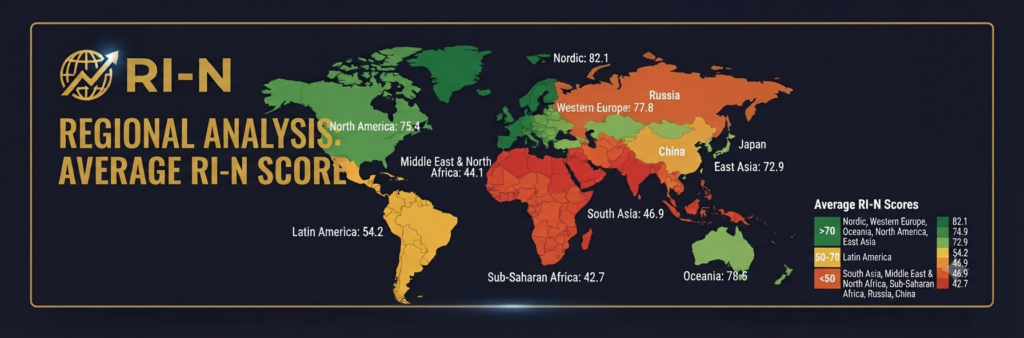
| Nordic | 82.1 | 4 | Denmark (85.0) |
| Western Europe | 77.8 | 18 | Switzerland (84.3) |
| Oceania | 78.5 | 3 | New Zealand (78.5) |
| North America | 75.4 | 3 | Canada (77.0) |
| East Asia | 72.9 | 4 | Japan (72.9) |
| Latin America | 54.2 | 12 | Chile (67.6) |
| South Asia | 46.9 | 7 | India (51.3) |
| Sub‑Saharan Africa | 42.7 | 30 | South Africa (52.0) |
| Middle East & North Africa | 44.1 | 14 | UAE (62.6) |
Nordic countries lead all regions with an average of 82.1, significantly above the global mean. Sub‑Saharan Africa (42.7) and MENA (44.1) trail the global average by roughly 10 points, underscoring the governance and institutional challenges in those regions.
7. Key Insights
7.1 Nordic Countries Lead
Denmark ranks #1 globally with a score of 85.0, followed by Switzerland (84.3) and Norway (81.9). The Nordic countries consistently demonstrate excellence across all six dimensions, particularly in Rule of Law, Anti-Corruption, and Human Rights.
7.2 Singapore: Asia’s Leader
Singapore ranks 15th globally with a score of 76.2. Its Anti-Corruption score (84.0) is among the highest in the world, while its Public Safety (77.7) and Rule of Law (78.0) are also notably strong.
7.3 Taiwan and Hong Kong
Taiwan ranks 18th globally with a score of 73.8 (Proficient), while Hong Kong ranks 23th with 71.8 (Proficient). Both achieve high scores in Human Rights and Freedom, but lower scores in Rule of Law and National Responsibility relative to their other dimensions.
7.4 Major Economies Comparison
| Country | Rank | RI-N Score |
|---|---|---|
| Germany | 8 | 78.2 |
| United Kingdom | 10 | 77.5 |
| Canada | 12 | 77.0 |
| United States | 17 | 73.8 |
| Japan | 20 | 72.9 |
| France | 21 | 72.5 |
| South Korea | 26 | 70.1 |
| India | 55 | 51.3 |
| China | 84 | 45.2 |
| Russia | 109 | 40.2 |
7.5 Bottom Performers
| Rank | Country | RI-N Score |
|---|---|---|
| 135 | Haiti | 17.9 |
| 134 | Venezuela | 18.6 |
| 133 | North Korea | 19.8 |
| 132 | Sudan | 20.5 |
| 131 | Central African Republic | 21.2 |
| 130 | South Sudan | 21.8 |
| 129 | Yemen | 22.1 |
| 128 | Syria | 23.4 |
| 127 | Somalia | 24.8 |
| 126 | Afghanistan | 25.3 |
8. Limitations
| Limitation | Explanation |
|---|---|
| Year Inconsistency | Freedom dimension (2023) is older than other dimensions (2025) |
| Data Availability | Some countries lack complete National Responsibility data |
| Estimations | Some countries (e.g., Taiwan, Hong Kong) used regional averages for National Responsibility |
| Perception Data | Public Safety is based on Numbeo perception data, not official crime statistics |
9. Conclusion
The RI-N 2026 Global Report provides the first comprehensive assessment of national righteousness across 135 countries. The findings reveal that:
- Nordic countries lead in righteousness, demonstrating excellence across all six dimensions
- Rule of Law and Anti-Corruption are the most important predictors of national righteousness
- National Responsibility remains a significant gap for many countries, highlighting the need for greater global engagement
- Economic wealth alone does not guarantee righteousness — several developing countries outperform wealthier nations in specific dimensions
10. Download Dataset
The complete RI-N dataset is available for download:
- CSV Format: RI-N_Dataset_2026_Final.csv
Download links are available on the RI-N webpage.
11. About WiseRighteous Network
WiseRighteous Network is a global initiative dedicated to advancing righteousness in governance, business, and society. Through frameworks like RSS, RMF, RI, and RGS, WiseRighteous provides the tools and insights to build a world where righteousness drives success.
References
Acemoglu, D., & Robinson, J. A. (2012). Why nations fail: The origins of power, prosperity, and poverty. Crown Business.

Cato Institute. (2023). Human freedom index 2023. Cato Institute. https://www.cato.org/human-freedom-index

Deci, E. L., & Ryan, R. M. (2000). The "what" and "why" of goal pursuits: Human needs and the self-determination of behavior. Psychological Inquiry, 11(4), 227–268.

Fukuyama, F. (2011). The origins of political order: From prehuman times to the French Revolution. Farrar, Straus and Giroux.

North, D. C., Wallis, J. J., & Weingast, B. R. (2009). Violence and social orders: A conceptual framework for interpreting recorded human history. Cambridge University Press.

Numbeo. (2025). Crime index by country 2025. Numbeo. https://www.numbeo.com/crime/

OECD. (2008). Handbook on constructing composite indicators: Methodology and user guide. OECD Publishing. https://doi.org/10.1787/9789264043466-en

Sen, A. (1999). Development as freedom. Oxford University Press.

Transparency International. (2025). Corruption perceptions index 2025. Transparency International. https://www.transparency.org/en/cpi

United Nations Development Programme. (2024). Human development report 2023–24: Breaking the gridlock: Reimagining cooperation in a polarized world. UNDP.

V-Dem Institute. (2025). Human rights index 2025. V-Dem Institute. https://www.v-dem.net/

World Intellectual Foundation. (2026). Responsible nations index 2026: Abridged global report. WIF Delhi. https://wifdelhi.org/

World Justice Project. (2025). Rule of law index 2025. World Justice Project. https://worldjusticeproject.org/rule-of-law-index
© 2026 WiseRighteous Network. All rights reserved.
This report is intended for informational purposes only. All data is drawn from publicly available sources and is provided without warranty of accuracy. Please refer to original sources for verification.
Building a World Where Righteousness Drives Success.