A Framework for Cultivating Integrity Through Positive Recognition and Reward
Published by: WiseRighteous Network | Righteous Advisory
Document Type: Implementation Framework
Version: 1.0
Alignment: RSS L1–L7 ·Righteous Index (RI) · Righteous Motivation Framework (RMF) · Righteous Growth Score (RGS)
Executive Summary
The Righteous Integrity Reward Framework (RIRF) provides organizations with a structured, culturally adaptable system for motivating and sustaining integrity and righteousness across their workforce. It addresses a critical gap in conventional ethics programs: the absence of positive, behavior-based reinforcement that makes integrity visible, valued, and developmentally consequential.
In this framework, “reward” is used in its broadest sense — encompassing formal awards, monetary and non-monetary prizes, public recognition, developmental opportunities, peer appreciation, and encouraging feedback — all deployed as positive reinforcement to increase motivation toward righteous behavior.
The RIRF is a practical application of the Righteous Motivation Framework (RMF) to the domain of recognition and reward. It specifically operationalizes two RMF clusters:
- Meaning & Achievement: RIRF’s recognition tiers activate the “Recognition” sub-cluster (PROUD, REPUTATION, INFLUENCE, INSPIRATION).
- Relational: RIRF’s peer recognition mechanism activates the “AFFIRMATION” factor (being recognized and encouraged by others).
The RIRF operates under Layer 3 — Alignment of the Righteous Standards System (RSS), which addresses “consistency between values, actions, and incentives.” It aligns organizational incentives with righteous behavior, ensuring that what is rewarded reflects what is valued.
Research consistently demonstrates that recognition significantly enhances extrinsic motivation by validating employees’ contributions, fostering a sense of achievement, and encouraging task completion, while appreciation strengthens intrinsic motivation by fulfilling psychological needs for relatedness, competence, and autonomy (Garuda, 2025). The RIRF operationalizes these findings into a practical framework for organizational integrity.
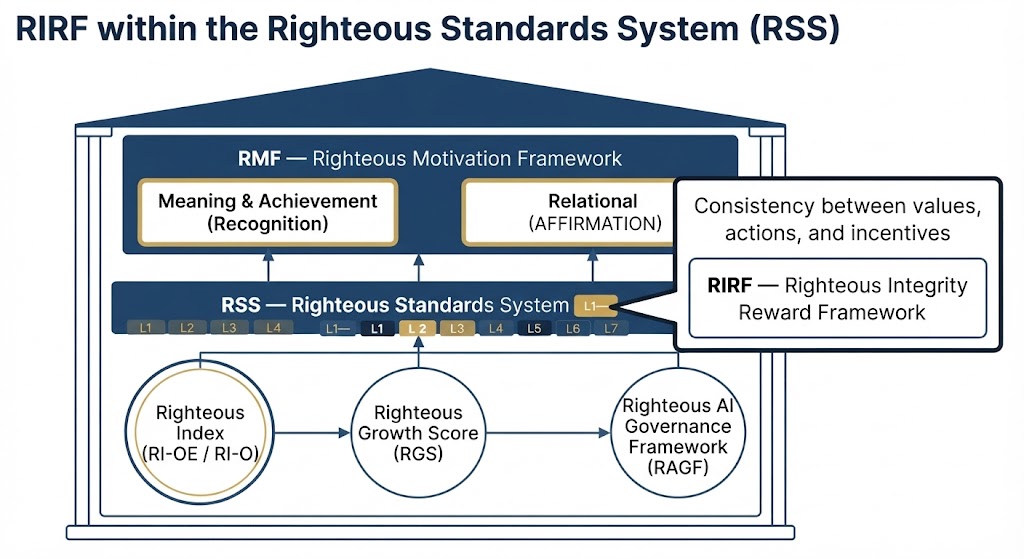
Figure 1. RIRF Position within the RSS Architecture
1. Purpose and Scope
1.1 Purpose
To establish a standardized, scalable, and culturally adaptable reward system that:
- Makes integrity and righteous behavior observable, recognized, and celebrated at all organizational levels.
- Links recognition to career development, performance evaluation, and promotion — not merely to symbolic or financial incentives (Shahid, 2025).
- Provides a measurable feedback loop that feeds into the Righteous Index (RI-OE and RI-O) and the Righteous Growth Score (RGS).
- Operates effectively across diverse cultural, legal, and organizational contexts.
- Serves as the positive reinforcement mechanism that aligns organizational incentives with righteous behavior under RSS Layer 3 — Alignment.
1.2 Scope
This framework applies to all employee groups, including full-time, part-time, contract, and international staff. It is designed for organizations of varying sizes, from small enterprises to multinational corporations, and can be adapted for nonprofit, governmental, and educational institutions.
2. Alignment with the Righteous Standards System
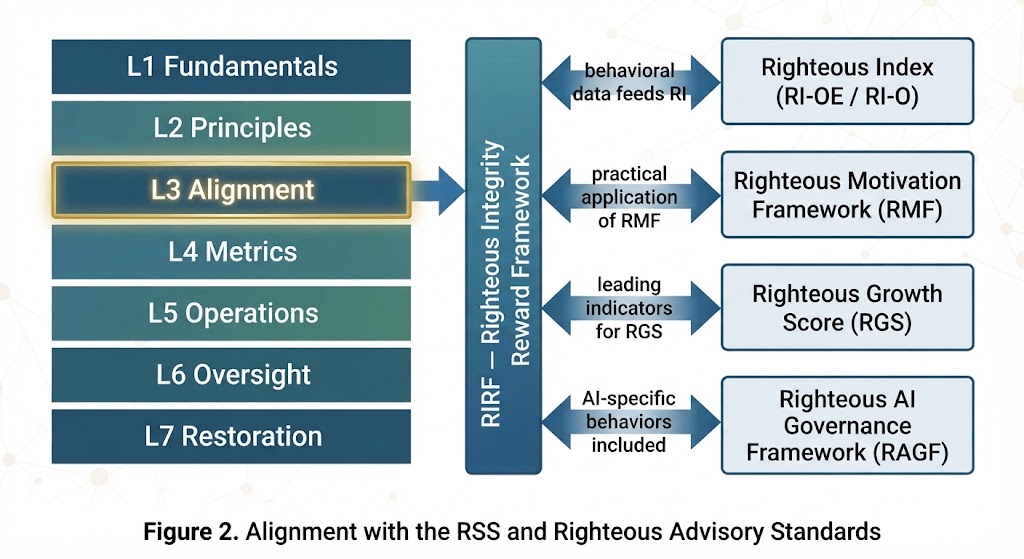
The RIRF is not a standalone program. It is a component framework within the Righteous Standards System (RSS), positioned under Layer 3 — Alignment, and serves as a practical application of the Righteous Motivation Framework (RMF).
2.1 Position within the RSS Standard Catalog
The RSS framework provides a comprehensive, ISO-aligned standard for operationalizing righteousness across individuals and institutions, built on seven interdependent layers (Righteous Advisory, 2026a). The RIRF occupies the following position within that architecture.
Table 1. RIRF Position within the RSS Seven-Layer Architecture
| RSS Layer | Standard | Function | Relationship to RIRF |
|---|---|---|---|
| L1 — Fundamentals | RSS 37001:2026 | Universal, non-negotiable principles | Provides the axioms RIRF recognition behaviors must reflect |
| L2 — Foundation | RSS 37002:2026 | Core values that guide action | Supplies the principles underpinning the Behavior Dictionary |
| L3 — Alignment | RSS 37003:2026 | Consistency between values, actions, and incentives | Parent layer. RIRF aligns organizational incentives with righteous behavior |
| L4 — Structure | RSS 37004:2026 | Clear roles, responsibilities, governance | Defines governance roles (Integrity Council, Program Owner, Ambassadors) |
| L5 — Process | RSS 37005:2026 | Standardized procedures for righteous outcomes | Provides the process discipline for nomination, review, and award cycles |
| L6 — Assurance | RSS 37006:2026 | Evaluation, verification, feedback | Supplies the audit and verification approach for RIRF measurement |
| L7 — Restoration | RSS 37007:2026 | Correction and recovery when righteousness is broken | Not directly related — RIRF is positive reinforcement, not corrective |
2.2 Alignment with Righteous Advisory Standards
Table 2. Alignment with Righteous Advisory Standards
| Righteous Advisory Standard | RIRF Integration Point |
|---|---|
| Righteous Index (RI) | Recognition behaviors map to RI-OE and RI-O dimensions. Recognition data feeds into RI scoring. |
| Righteous Motivation Framework (RMF) | RIRF is a practical application of RMF. It activates the “Recognition” sub-cluster (Meaning & Achievement) and the “AFFIRMATION” factor (Relational). |
| Righteous Growth Score (RGS) | Recognition frequency, participation rates, and behavioral coverage serve as leading indicators for RGS trajectory. An increase in RIRF activity should precede a positive RGS. |
| Righteous AI Governance Framework (RAGF) | For AI-related roles and projects, RIRF includes AI-specific integrity behaviors (e.g., transparency in AI decision-making, fairness in algorithmic outcomes). |
| RSS Standard Catalog | The authoritative index of all standards. RIRF is registered under Layer 3 — Alignment. |
2.3 RMF Cluster Mapping
RIRF operationalizes specific factors from the Righteous Motivation Framework (RMF).
Table 3. RIRF Activation of RMF Factors
| RMF Cluster | RMF Factor | How RIRF Activates It |
|---|---|---|
| Meaning & Achievement → Recognition | PROUD | Public recognition creates justifiable pride in one’s actions |
| Meaning & Achievement → Recognition | REPUTATION | Recognition builds a good name over time |
| Meaning & Achievement → Recognition | INFLUENCE | Recognized employees positively shape others |
| Meaning & Achievement → Recognition | INSPIRATION | Recognized employees inspire others to goodness |
| Relational → Care & Support | AFFIRMATION | Peer recognition provides being recognized and encouraged by others |
The integration of recognition data with the Righteous Index and Righteous Growth Score aligns with established measurement frameworks such as the NIST AI Risk Management Framework, which emphasizes continuous monitoring and assessment of organizational behavior (National Institute of Standards and Technology, 2023).
3. Design Principles
The RIRF is built on seven principles that ensure effectiveness, cultural adaptability, and alignment with righteous values.
Table 4. Design Principles of the RIRF
| Principle | Description |
|---|---|
| Behavior-Based | Recognition is tied to specific, observable actions — not vague praise or personality traits. |
| Development-Linked | Recognition contributes to career advancement, learning opportunities, and performance evaluation. |
| Multi-Channel | Peer, manager, team, and annual recognition mechanisms reach different motivational profiles. |
| Globally Adaptable | Core framework remains consistent; examples, rewards, and delivery are localized. |
| Transparent and Fair | Clear criteria, cross-functional review, and an appeals process ensure credibility. Research demonstrates that recognition must be equitable and based on merit to be effective, with transparency and freedom from favoritism as essential conditions (Incentive Research Foundation, 2025). |
| Leadership-Backed | Senior leaders visibly participate, model integrity, and sponsor the program. |
| Non-Punitive | Operates separately from disciplinary systems; focuses exclusively on positive reinforcement. |
4. Core Components
4.1 Integrity Behavior Dictionary
Organizations define 5–7 observable behaviors that reflect integrity in their specific context. These behaviors align with the 7 RSS layers, ensuring consistency with the Righteous Index and the Righteous Standards System.
Table 5. Integrity Behavior Dictionary Aligned with RSS Layers
| RSS Layer | Behavior Focus | Observable Action Examples |
|---|---|---|
| L1 — Fundamentals | Honesty, respect, fairness, responsibility | Reports mistakes promptly; treats others with dignity; applies rules consistently |
| L2 — Foundation | Values and beliefs guiding action | Acts on stated values even when inconvenient; aligns choices with principles |
| L3 — Alignment | Consistency between values, actions, and incentives | Does not exploit incentives against values; aligns conduct with stated commitments |
| L4 — Structure | Roles, responsibilities, governance | Fulfills role duties reliably; escalates appropriately; respects governance boundaries |
| L5 — Process | Standardized procedures for righteous outcomes | Follows procedures faithfully; improves processes when they produce harm |
| L6 — Assurance | Verification, evaluation, feedback | Invites scrutiny; reports accurately; supports audits and reviews |
| L7 — Restoration | Recovery, learning, improvement from failures | Owns mistakes; participates in repair; helps others recover from failure |
Each behavior should include 2–3 real-world examples relevant to different roles, regions, and levels of seniority. The OECD AI Principles emphasize that AI actors should be accountable for the proper functioning of AI systems and compliance with principles including traceability of datasets and processes, a standard that extends naturally to human integrity behaviors (OECD, 2024).
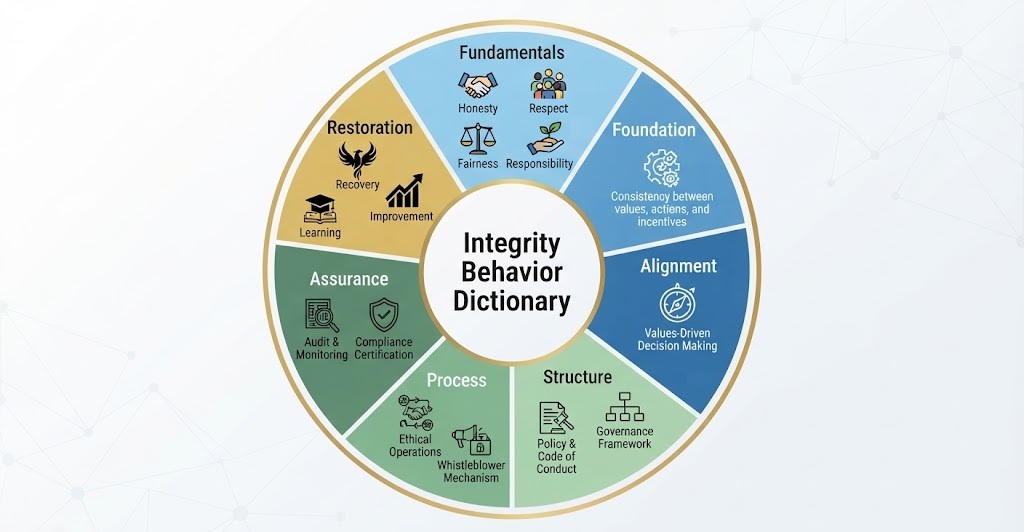
Figure 3. Integrity Behavior Dictionary Wheel
4.2 Recognition Tiers
The framework uses a four-tier recognition structure to accommodate different motivational drivers and organizational levels.
Table 6. Four-Tier Recognition Structure
| Tier | Mechanism | Frequency | Nominator | Reward Type |
|---|---|---|---|---|
| 1. Peer Spot | Digital badge / points | Real-time | Any employee | Points, public thanks, small perks |
| 2. Manager / Team | Monthly or quarterly award | Monthly / Quarterly | Managers, team leads | Certificate, team celebration, points |
| 3. Annual Integrity Award | Organization-wide recognition | Annual | Cross-functional Integrity Council | Public award, development budget, promotion consideration |
| 4. External Benchmark | Ethisphere, compliance awards | Annual | Leadership / Ethics Office | External validation, PR, recruitment advantage |
Peer-driven recognition has been shown to have a more sustained motivational and cultural impact than traditional reward-based systems (Zenodo, 2025). Companies recognized by Ethisphere’s World’s Most Ethical Companies program outperformed a comparable index of global companies by 12.3 percentage points over a five-year period, demonstrating a measurable link between ethical culture and financial performance (Ethisphere, 2024).
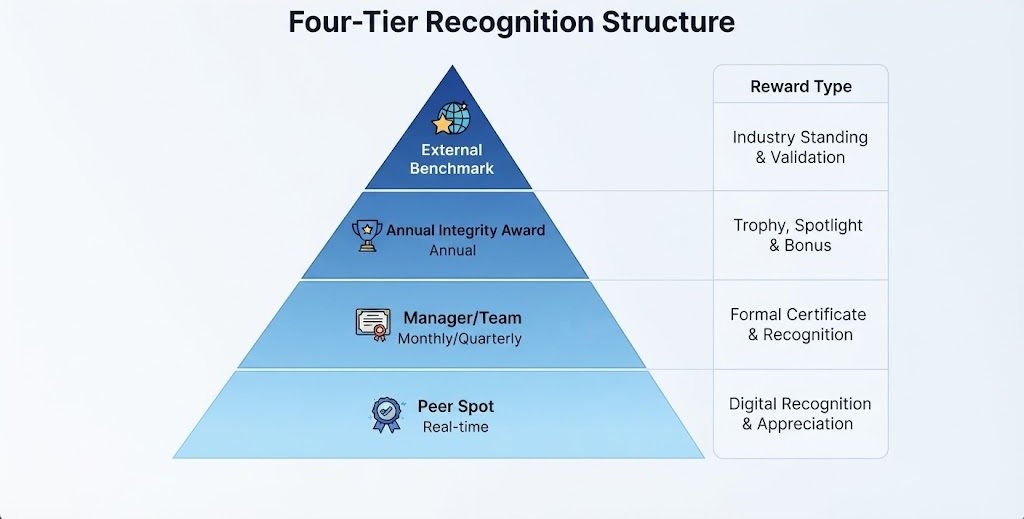
Figure 4. Four-Tier Recognition Structure
4.3 Reward and Development Linkage
The RIRF deliberately avoids over-reliance on cash incentives, which research shows can undermine intrinsic motivation and create perceptions of inauthenticity (Shahid, 2025). Non-monetary incentives are even more effective in activating intrinsic motivation, and employees who feel they are trusted, appreciated, and recognized will be motivated to reciprocate through strong performance (OECD, 2018).
Table 7. Reward and Development Linkage
| Reward Category | Examples | Purpose |
|---|---|---|
| Intrinsic | Public recognition, peer admiration, meaningful assignments | Reinforces internal motivation |
| Developmental | Learning stipends, conference attendance, mentorship | Links integrity to growth |
| Career | Documented in performance reviews; considered for promotion | Signals long-term value |
| Tangible | Points redeemable for flexible work, extra leave, charitable donations | Provides flexibility across cultures |
| Team-Based | Group rewards for collective integrity | Reinforces community and shared values |
Key Rule: Integrity recognition supplements — and never replaces — fair base pay and ethical leadership.
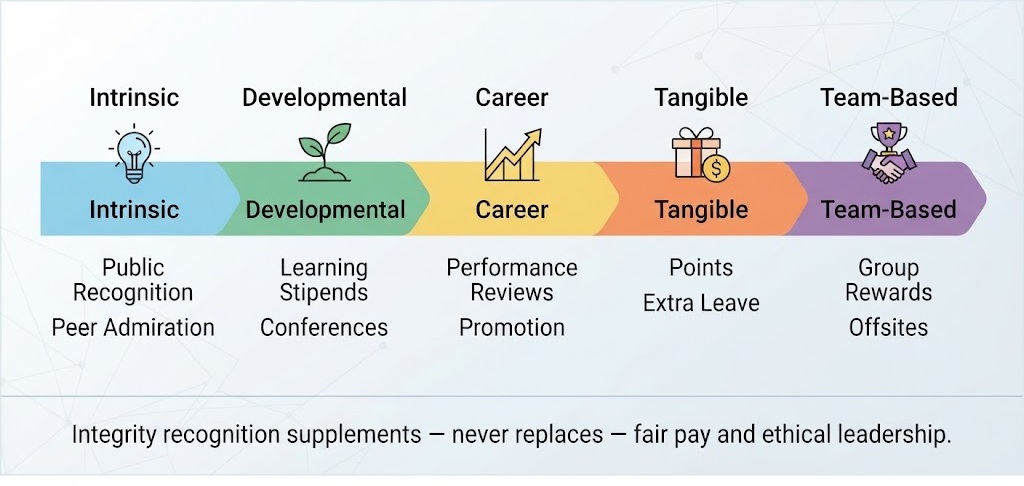
Figure 5. Reward and Development Linkage
4.4 Measurement System
The RIRF includes a measurement architecture that feeds directly into the Righteous Index (RI-OE and RI-O) and the Righteous Growth Score (RGS).
Table 8. Measurement System and RI/RGS Linkage
| Metric | What It Measures | RI/RGS Linkage | Target |
|---|---|---|---|
| Participation Rate | % employees giving/receiving recognition | RI-OE — Culture of Integrity | >40% |
| Recognition Volume | Integrity recognitions per month | RGS — Leading Indicator | 2× baseline |
| Behavior Coverage | % of defined behaviors recognized | RI-OE — Dimensional Coverage | All 7 layers |
| Promotion Correlation | % award winners promoted within 18 months | RGS — Career Growth Link | >50% |
| Culture Survey | Integrity score improvement | RI-O — Perceptual Index | +5–10 points |
| Misconduct Reports | Early increase then decline | RI-O — Trust Indicator | Initial rise, then decline |
| Turnover | Voluntary turnover in program vs. control | RGS — Retention Impact | Lower or equal |
Organizations that practice recognition effectively are 12 times more likely to have strong business outcomes, and recognition programs are associated with 31% lower voluntary turnover (Deloitte, as cited in Vantage Circle, 2026). The measurement approach aligns with ISO/IEC 42001, which requires organizations to establish, implement, maintain, and continually improve an AI management system, including documented information and competence requirements (ISO/IEC, 2023).
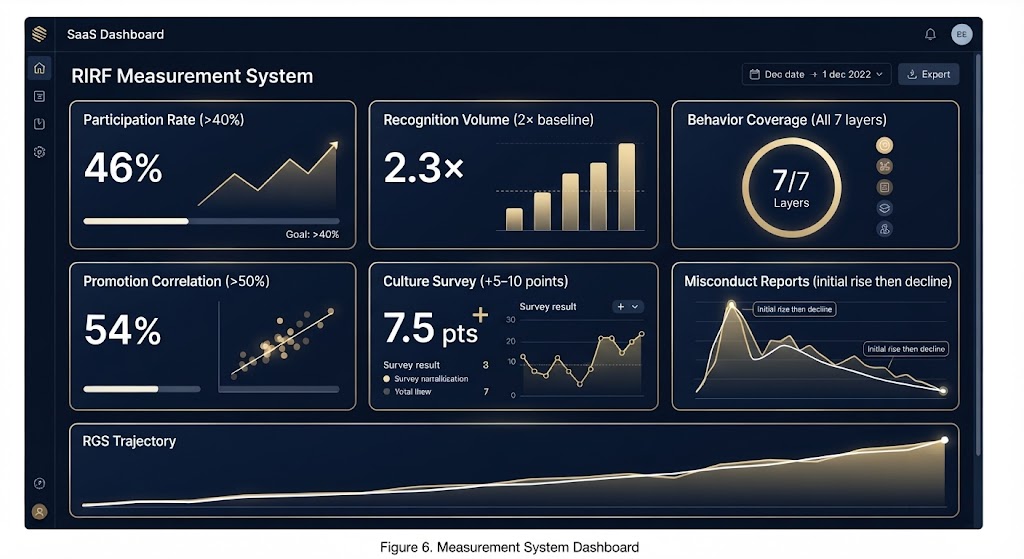
Figure 6. Measurement System Dashboard
4.5 Governance Structure
Table 9. Governance Roles and Responsibilities
| Role | Responsibility |
|---|---|
| Integrity Council | Cross-functional, global representation. Reviews annual awards, ensures fairness. |
| Program Owner | HR or Ethics & Compliance. Manages platform, training, reporting. |
| Local Ambassadors | Regional representatives. Translate materials, nominate, gather feedback. |
| Ombuds / Appeals | Independent channel for disputes and procedural concerns. |
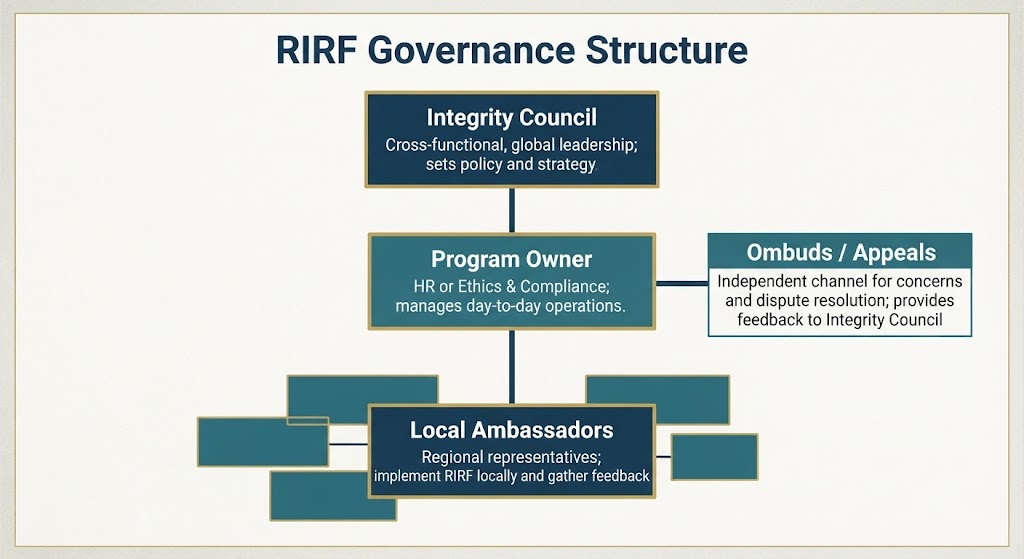
Figure 7. Governance Structure
4.6 Communication and Training
- Launch Campaign: “Integrity in Action” — featuring real stories from leaders and peers.
- Manager Toolkit: Guidance on how to spot, nominate, and celebrate integrity.
- Workshops: “What does integrity look like in your role?” — department-specific sessions.
- Storytelling: Monthly newsletter or intranet features on recognized employees.
5. Implementation Roadmap
Table 10. Implementation Roadmap
| Phase | Timeline | Key Activities |
|---|---|---|
| 0. Assess | Month 1 | Culture audit, baseline survey, review existing recognition programs. |
| 1. Design | Months 2–3 | Define behaviors, select implementation group, build platform/process, train ambassadors. |
| 2. Implement | Months 4–9 | Run in one region or department. Monthly check-ins, iterative adjustments. |
| 3. Evaluate | Month 10 | Compare metrics vs. baseline; gather qualitative feedback. |
| 4. Scale | Months 11–12+ | Adapt, expand to other regions, integrate into performance systems. |
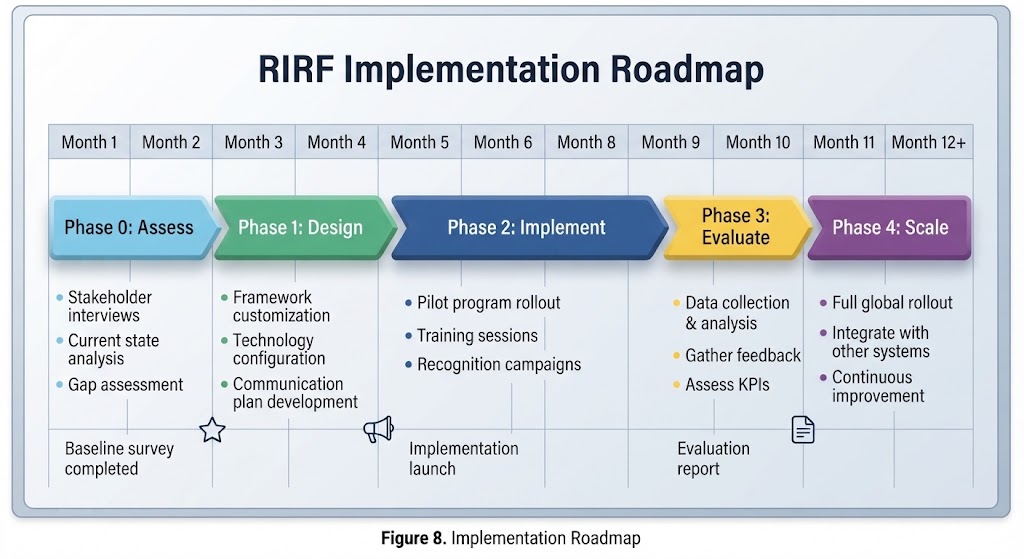
Figure 8. Implementation Roadmap
6. Risk Mitigation
Table 11. Risk Mitigation Strategies
| Risk | Mitigation Strategy |
|---|---|
| Crowding out intrinsic motivation | Emphasize public recognition and development over cash. Self-Determination Theory research demonstrates that bonuses can promote unintended consequences and that incentive schemes are most effective when they convey clear goals and values with a vision of enhanced intrinsic motivation (Self-Determination Theory, 2024). |
| Perceived favoritism | Cross-functional review, transparent criteria, appeals process. |
| Cultural discomfort with public praise | Offer private recognition options; let employees choose visibility. |
| Low participation | Leader modeling, simple nomination process, local ambassadors. |
| One-off campaign fizzle | Embed into annual performance cycle and existing platforms. |
| Legal / data privacy issues | Comply with GDPR, local labor laws; anonymize survey data. |
| Inauthenticity perception | Emphasize that rewards follow integrity — they do not purchase it. |
7. Global Adaptation Matrix
Table 12. Global Adaptation Matrix
| Cultural Dimension | Adaptation Strategy |
|---|---|
| Collectivist vs. Individualist | Balance individual and team awards; emphasize team recognition in collectivist contexts. |
| High vs. Low Power Distance | In high power distance, ensure peer nominations are safe; offer anonymous options. |
| Public vs. Private Praise Preference | Allow employees to choose public or private recognition. |
| Language | Translate behavior dictionary and nomination forms; use local examples. |
| Legal / Tax | Verify tax implications of tangible rewards; ensure compliance with local labor law. |
| Religious / National Holidays | Time award ceremonies around locally meaningful dates. |
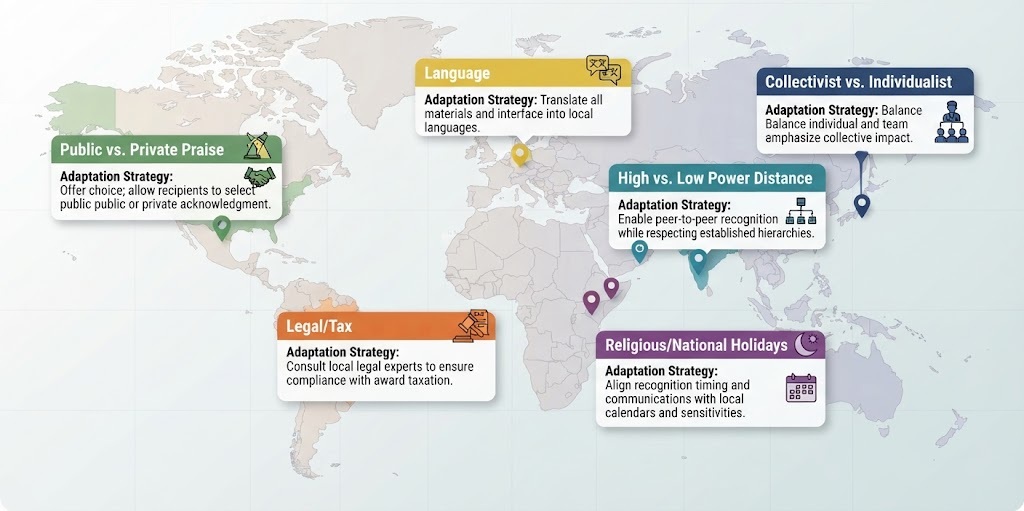
Figure 9. Global Adaptation Matrix
8. Sample Award Categories
Table 13. Sample Award Categories
| Award | Description |
|---|---|
| Integrity Champion | Consistent modeling of all integrity behaviors. |
| Ethical Courage | Speaking up on a difficult issue. |
| Stewardship Excellence | Protecting resources, data, or reputation. |
| Fairness Advocate | Promoting equity and unbiased decisions. |
| Transparency Leader | Open, honest communication. |
| Accountability Hero | Owning mistakes and fixing them. |
| Righteous Innovation | Applying integrity principles to new products, services, or processes. |
9. Sample Point Structure
Points accumulate over a 12-month period. Redemption options should be localized. The 双环传动 (Shuanghuan Driveline) case demonstrates the effectiveness of a quantified points-based system. The company’s “Moral Integrity Points” system ties daily behaviors across five dimensions — family culture, improvement culture, striving culture, goal culture, and responsibility culture — directly to annual promotions and performance evaluations. In just the first eight months of 2025, the company recorded 54 incidents of employees returning lost property, involving tens of thousands of yuan, with the system applied uniformly to all 3,000+ employees, including foreign staff (Taizhou News, 2025).
Table 14. Sample Point Structure
| Action | Points | Redeemable For |
|---|---|---|
| Peer Spot Recognition | 10 | Badge, coffee voucher |
| Manager Award | 50 | Extra leave day, learning stipend |
| Annual Award | 500 | Promotion consideration, conference trip |
| Team Award | 100 per member | Team offsite, group dinner |
10. Nomination Form Template
- Nominator: (optional anonymous)
- Nominee:
- Integrity Behavior Demonstrated: (dropdown from Behavior Dictionary)
- Specific Action: (what did they do?)
- Impact: (who benefited and how?)
- Visibility Preference: (public / private)
- Supporting Evidence: (optional)
11. Program Scorecard (Example)
Table 15. Program Scorecard Example
| Dimension | Baseline | Target | Data Source |
|---|---|---|---|
| Recognition Participation | 5% | 40% | Platform analytics |
| Integrity Culture Score | 62/100 (Developing) | 70/100 (Proficient) | Pulse survey |
| Annual Award Nominations | 20 | 80 | Committee records |
| Promotion of Award Winners | N/A | 50% within 18 months | HR data |
| Voluntary Turnover | 15% | ≤15% | HR data |
12. Integration with the Righteous Standards System
The RIRF functions as a practical application of the Righteous Motivation Framework (RMF) and aligns organizational incentives with righteous behavior under Layer 3 — Alignment of the RSS.
Table 16. Integration with the Righteous Standards System
| RSS Layer / Standard | RIRF Contribution |
|---|---|
| L3 — Alignment (RSS 37003) | RIRF aligns organizational incentives (rewards) with righteous values and actions. |
| RMF — Righteous Motivation Framework | RIRF activates the “Recognition” sub-cluster (Meaning & Achievement) and the “AFFIRMATION” factor (Relational). |
| Righteous Index (RI) | Recognition data provides behavioral evidence for RI-OE and RI-O scoring. |
| Righteous Growth Score (RGS) | Recognition trends serve as leading indicators for RGS trajectory. An increase in RIRF activity should precede a positive RGS. |
| Righteous AI Governance Framework (RAGF) | AI-specific integrity behaviors are included in the Behavior Dictionary for AI-related roles. |
The RAGF component aligns with the NIST AI Risk Management Framework’s emphasis on trustworthy AI and the OECD AI Principles’ focus on human rights, transparency, and accountability (OECD, 2024).
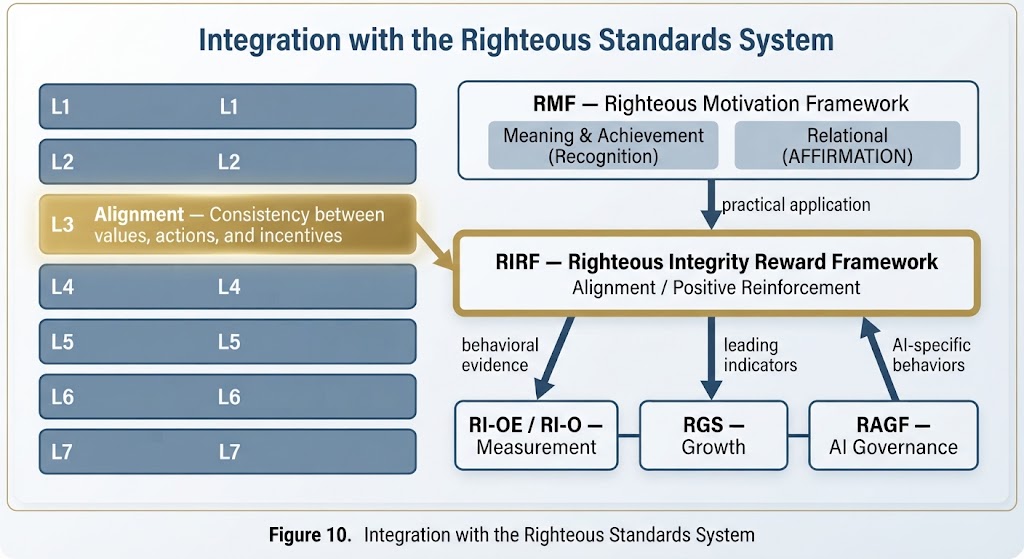
Figure 10. Integration with the Righteous Standards System
13. Case Studies
The following case studies illustrate the practical application of RIRF principles across diverse organizational contexts.
13.1 Orica — Peer-to-Peer Recognition Centered on Integrity
Organization: Orica, a global mining and infrastructure solutions company.
The Challenge: Orica’s five core values included integrity, but integrity consistently received fewer recognitions than any other value. Employees understood its importance in principle but found it harder to spot and describe what “acting with integrity” looked like in the flow of everyday work.
The Intervention: Orica launched a month-long integrity campaign through its existing employee recognition platform, bravO. Employees were invited to recognize peers, leaders, and teammates whose actions reflected integrity, and to share specific, real-world examples — from ethical decision-making and transparent communication to following through on commitments (Achievers, 2026a).
Outcome: The campaign sparked a surge in integrity recognitions and created sustained momentum that reinforced a values-led culture. By grounding recognition in everyday moments, Orica helped employees move past abstract definitions and build confidence in identifying integrity when they saw it.
13.2 Shuanghuan Driveline— Quantified “Moral Integrity Points”
Organization: 双环传动, a Chinese manufacturing company with over 3,000 employees, including foreign staff.
The Model: The company operates a “Moral Integrity Points” (品德积分) system that has been running for two years. Employee daily behaviors are quantified across five dimensions: family culture, improvement culture, striving culture, goal culture, and responsibility culture. Actions such as turning in lost property, choosing green transportation for business trips, and proactively reporting public facility repairs all earn points. The points are deeply tied to employee development — they directly affect annual promotions and performance evaluations. The system also includes a “mentor-apprentice” component, where experienced employees earn points and subsidies for training new hires (Taizhou News, 2025).
Outcome: In just the first eight months of 2025, the company recorded 54 incidents of employees returning lost property, involving tens of thousands of yuan. The system has been applied uniformly to all 3,000+ employees, including all foreign staff, ensuring undifferentiated coverage of the integrity culture.
13.3 Würth Canada — Embedding Integrity into Every Recognition Moment
Organization: Würth Canada, a leading industrial supplier serving Canadian businesses.
The Model: Würth Canada built its recognition platform, Wurth Excellence, around ten Cultural Attributes of High Performance — one of which is Integrity. Every recognition sent through the platform is tied to one of these ten attributes. This structure ensures that recognition does not merely celebrate results, but spotlights the behaviors behind them — turning values into daily signals that employees can see, feel, and repeat (Achievers, 2026b).
Measurable Results:
- 20% increase in Glassdoor rating
- 60% reduction in turnover
- 100% increase in average productivity per employee
13.4 Unilever — Annual Values Awards with Integrity as a Core Category
Organization: Unilever ANZ (Australia and New Zealand).
The Model: Unilever ANZ holds Annual Value Awards that recognize employees across its core business values: Courage, Integrity, Tenacity, Curiosity, Mateship, Ownership, and Fun. Integrity is a standing award category, not a one-off campaign. Employees can be recognized multiple times across different values over their tenure — one R&D leader received the Integrity award in 2024, having previously been recognized for Curiosity in 2022 (Unilever ANZ, 2024).
Why It Matters: Making integrity a permanent, annual award category signals that it is an enduring expectation, not a temporary initiative. It also creates a public record of integrity role models within the organization, reinforcing the behavior through visibility and peer admiration.
13.5 Ethisphere’s World’s Most Ethical Companies — A Global Benchmark Model
The Model: Ethisphere’s World’s Most Ethical Companies® recognition is a global organizational benchmark that assesses companies across five categories: Culture of Ethics, Corporate Governance, Ethics & Compliance, Third-Party Management, and Environmental & Social Impact. Companies must document how they practice, measure, enforce, and advance organizational ethics.
Global Applicability: In 2024, 136 companies from 17 countries and 40 sectors were recognized. Honorees outperformed their peers by 12.3 percentage points on the Ethics Premium™ metric over a five-year period, demonstrating a measurable link between ethical culture and financial performance (Ethisphere, 2024).
Examples of companies using this model:
- Workday — recognized for the fourth consecutive year in 2024 (Workday, 2024)
- Aflac — recognized for the 18th consecutive year (Aflac, 2024)
- Western Digital — recognized for the sixth time (Western Digital, 2024)
14. Next Steps
To tailor the RIRF to your organization, the following inputs are recommended:
- Organizational Profile: Size, countries, languages, industry sector.
- Existing Recognition Infrastructure: Current awards, platforms, or incentive programs.
- Strategic Priority: Compliance, culture change, retention, or external benchmarking.
- Budget Range: Approximate investment for rewards and administration.
- Implementation Scope: Recommended starting group (one region, department, or business unit).
References
Achievers. (2026a). Orica customer story: How Orica brought its value of integrity to life through recognition. Achievers. https://www.achievers.com/
Achievers. (2026b). Würth customer story: Wurth Canada turned recognition into a strategic driver of performance. Achievers. https://www.achievers.com/
Ethisphere. (2024, March 4). Ethisphere announces the 2024 World’s Most Ethical Companies. Ethisphere. https://ethisphere.com/
Garuda. (2025). The dual effects of recognition and appreciation on employee motivation and performance. Garuda: Garba Rujukan Digital. https://garuda.kemdiktisaintek.go.id/documents/detail/4815529
Incentive Research Foundation. (2025, August 11). Academic research in action: Driving worker performance through effective recognition and rewards. Incentive Research Foundation. https://theirf.org/
ISO/IEC. (2023). ISO/IEC 42001:2023 — Information technology — Artificial intelligence — Management system. International Organization for Standardization. https://www.iso.org/standard/81230.html
National Institute of Standards and Technology. (2023). Artificial Intelligence Risk Management Framework (AI RMF 1.0). U.S. Department of Commerce. https://www.nist.gov/itl/ai-risk-management-framework
OECD. (2018, March 27). Applying behavioural insights to integrity policies: Behavioural insights for public integrity. OECD Publishing. https://www.oecd.org/
OECD. (2024, May 3). OECD updates AI Principles to stay abreast of rapid technological developments. OECD. https://www.oecd.org/en/about/news/press-releases/2024/05/oecd-updates-ai-principles-to-stay-abreast-of-rapid-technological-developments.html
Righteous Advisory. (2026a). RSS Standard Catalog — Righteous Standards System: Seven-layer-aligned ISO-style catalog (2026 edition). WiseRighteous Network. https://advisory.wiserighteous.org/standard-catalog/
Righteous Advisory. (2026b). Righteous Index (RI) — Standard Catalog. WiseRighteous Network. https://advisory.wiserighteous.org/righteous-index-ri-standard-catalog/
Righteous Advisory. (2026c). Righteous Motivation Framework (RMF). WiseRighteous Network. https://advisory.wiserighteous.org/righteous-motivation-framework-rmf/
Righteous Advisory. (2026d). Righteous Growth Score Framework (RGS-F). WiseRighteous Network. https://advisory.wiserighteous.org/righteous-growth-score-framework-rgs-f/
Shahid, A. (2025). How often we underestimate the power of recognition: Don’t complicate it — make it transparent, genuine, and individualized. International Journal of Business Administration, 16(2), 1–17. https://www.sciedu.ca/journal/index.php/ijba/article/view/27635
Taizhou News. (2025, October 15). 做好事能加分!台州这家民企用”品德积分”激励员工 [Good deeds earn points! Taizhou private enterprise uses “moral integrity points” to motivate employees]. Taizhou News. https://tzapp.taizhou.com.cn/
Unilever ANZ. (2024, December 13). At Unilever ANZ, we foster a winning mindset by embracing core principles and business values. LinkedIn. https://www.linkedin.com/
Vantage Circle. (2026). The business case for employee recognition: What the research says. Vantage Circle. https://www.vantagecircle.com/
Zenodo. (2025, December 15). Peer recognition and strategic alignment: An empowerment-based leadership framework for ethical team development. Zenodo. https://zenodo.org/records/17937260