
Layer 2 — Foundation
Righteous Standards System (RSS)
0. Introduction
The Righteous Standards System (RSS) establishes a structured, layered framework for defining, practicing, and evaluating righteousness across individuals and institutions. Layer 2 — Foundation — defines the essential structural elements that support the application of the axioms established in RSS 37001.
This standard provides the core foundational components required for all higher‑layer standards, including Alignment (Layer 3), Structure (Layer 4), Process (Layer 5), Assurance (Layer 6), and Restoration (Layer 7).
0.1 Purpose of Layer 2
The purpose of the Foundation Layer is to:
- establish the core components that righteousness must rest upon
- define the universal domains through which righteousness operates
- provide the structural basis for alignment, processes, and assurance
- ensure that all higher layers remain grounded in the axioms of Layer 1
Layer 2 transforms the axioms into foundational elements that can be applied consistently across people and institutions.
0.2 Relationship to the Two‑Pillar Architecture
All foundational components defined in this standard apply equally to the two universal pillars of righteousness:
- People
- Institutions
These pillars, introduced in RSS 37001, form the structural basis for all domains and components defined in this standard.
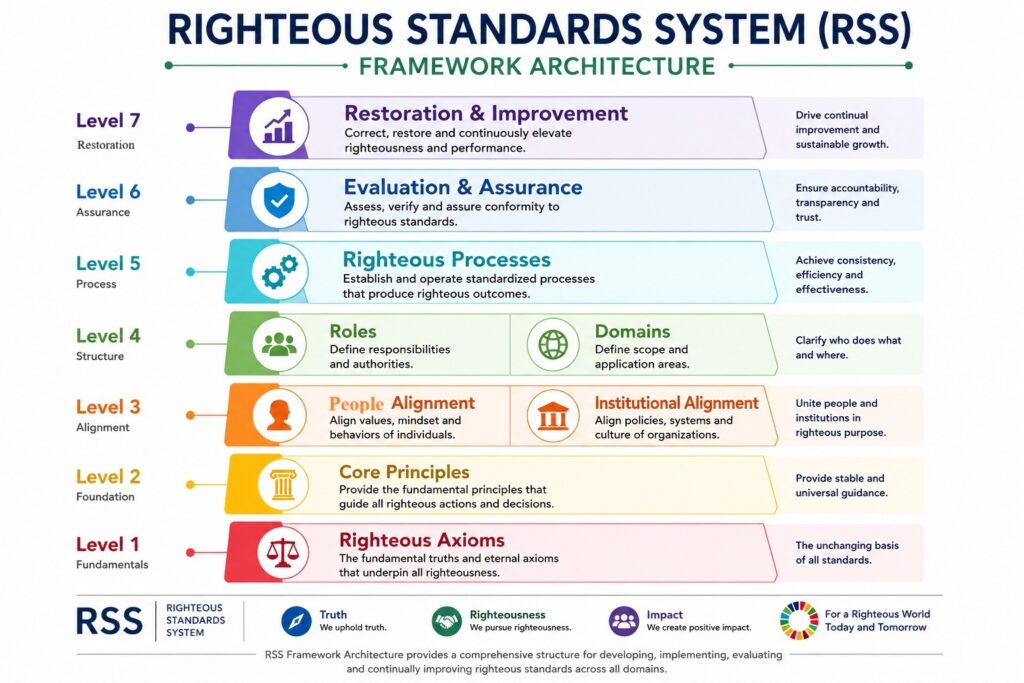
Figure 2.1 — Foundation Layer Overview
1. Scope
This standard applies to:
- individuals
- organizations
- institutions
- systems
- policies
- social structures
It defines the foundational components required for the consistent application of righteousness across all domains and contexts.
2. Normative References
This standard is self‑contained. The only normative reference is:
- RSS 37001:2026 — Fundamentals Standard
3. Terms and Definitions
All terms and definitions in this standard are authoritative for all higher‑layer RSS standards. Definitions in this document take precedence over definitions in any other RSS standard.
4. Structure of This Standard
This standard contains two normative components:
- RSS 37002‑2.1 — Foundational Components
- RSS 37002‑2.2 — Foundational Domains
These components define the essential building blocks upon which all higher‑layer standards are constructed.
5. RSS 37002‑2.1 — Foundational Components
The following components form the core foundation required for righteousness to function consistently across people and institutions.
Component 1 — Moral Intent
All righteous action must originate from a sincere internal intent aligned with integrity and the core virtues defined in Axiom 2.
Component 2 — Ethical Awareness
Individuals and institutions must maintain awareness of:
- the moral implications of their actions
- the impact of their decisions
- the alignment between intent and outcome
Ethical awareness is a prerequisite for righteous behavior.
Component 3 — Value Consistency
Righteousness requires consistency between:
- stated values
- internal beliefs
- external actions
Misalignment between these elements weakens the foundation of righteousness.
Component 4 — Responsibility Ownership
People and institutions must accept responsibility for:
- their actions
- their decisions
- their influence
- their failures
Responsibility ownership is essential for restoration and continuous improvement.
Component 5 — Commitment to Truthfulness
Righteousness requires a commitment to:
- honesty
- transparency
- accuracy
- truth‑seeking
Truthfulness is a non‑negotiable foundation for all righteous systems.
6. RSS 37002‑2.2 — Foundational Domains
The following domains represent the universal areas in which righteousness must be applied. These domains form the structural basis for alignment (Layer 3) and structure (Layer 4).
Domain 1 — Personal Conduct
The domain of individual behavior, including:
- moral choices
- interpersonal interactions
- self‑discipline
- integrity in daily life
Domain 2 — Institutional Conduct
The domain of organizational behavior, including:
- governance
- policies
- decision‑making
- accountability structures
Domain 3 — Relational Justice
The domain governing fairness and justice in relationships, including:
- respect
- equity
- conflict resolution
- mutual responsibility
Domain 4 — Social Responsibility
The domain governing the impact of actions on society, including:
- community welfare
- public trust
- ethical influence
- stewardship
Domain 5 — Corrective Action
The domain governing restoration when righteousness is broken, including:
- reflection
- admission of fault
- correction
- reconciliation
This domain directly supports Axiom 4.
7. Conformance Requirements
To conform to RSS 37002, an entity shall:
- apply all foundational components consistently
- operate within all foundational domains
- ensure alignment with the axioms defined in RSS 37001
- maintain value consistency across people and institutions
- uphold responsibility ownership and truthfulness
8. Relationship to Other Layers
RSS 37002 directly informs:
- RSS 37003 — Alignment Standard
- RSS 37004 — Structure Standard
- RSS 37005 — Process Standard
- RSS 37006 — Assurance Standard
- RSS 37007 — Restoration Standard
All higher layers depend on the foundational components and domains defined in this standard.