
A Practical Guide to Applying the Righteous Standards System for People and Organization Growth
Abstract
This article presents a comprehensive framework for empowering individual and collective motivation motivation through the Righteous Standards System (RSS). Drawing on established organizational behavior research and real-world case studies from Toyota, Costco, and Singapore, we argue that righteous motivation—motivation rooted in integrity, purpose, and ethical commitment—is more powerful and sustainable than motivation driven by external rewards alone. The article introduces the RSS seven-layer standard, maps it to five practical clusters of individual and collective motivation, and provides actionable guidance for both leaders and employees. When righteousness becomes the foundation of organizational culture, employees no longer see a trade-off between “doing right” and “succeeding”—they discover that righteousness is the most reliable path to lasting success.
Chapter 1: Introduction — The Missing Link in People Motivation
Every organization leader has faced the same frustrating question: “Why do my employees seem unmotivated, even when I offer bonuses, promotions, and incentives?”
The answer is surprisingly simple: External rewards alone cannot inspire lasting commitment. They can buy compliance, but they cannot buy passion. They can drive short-term performance, but they cannot sustain long-term engagement.
What is missing is righteousness — the alignment of values, actions, and purpose. When people feel that their work is meaningful, that they are treated fairly, and that they can trust their leaders, they become motivated from within. This is not a soft, feel-good concept. It is a strategic advantage that drives sustainable success.
This article is for leaders who want to build a culture of righteous motivation, and for people who want to grow in their own commitment to integrity and purpose.
It is structured around the Righteous Standards System (RSS) , a seven-layer framework that provides a systematic approach to embedding righteousness into organizational DNA. We will explore how the RSS framework applies to people motivation through five practical clusters, and provide actionable steps for both leaders and people.
Chapter 2: What Is the RSS Framework?
The Righteous Standards System (RSS) is a comprehensive, ISO-aligned standard for operationalizing righteousness across individuals and institutions. It is built on seven interdependent layers, each building upon the one below it, creating a complete system for righteousness governance.
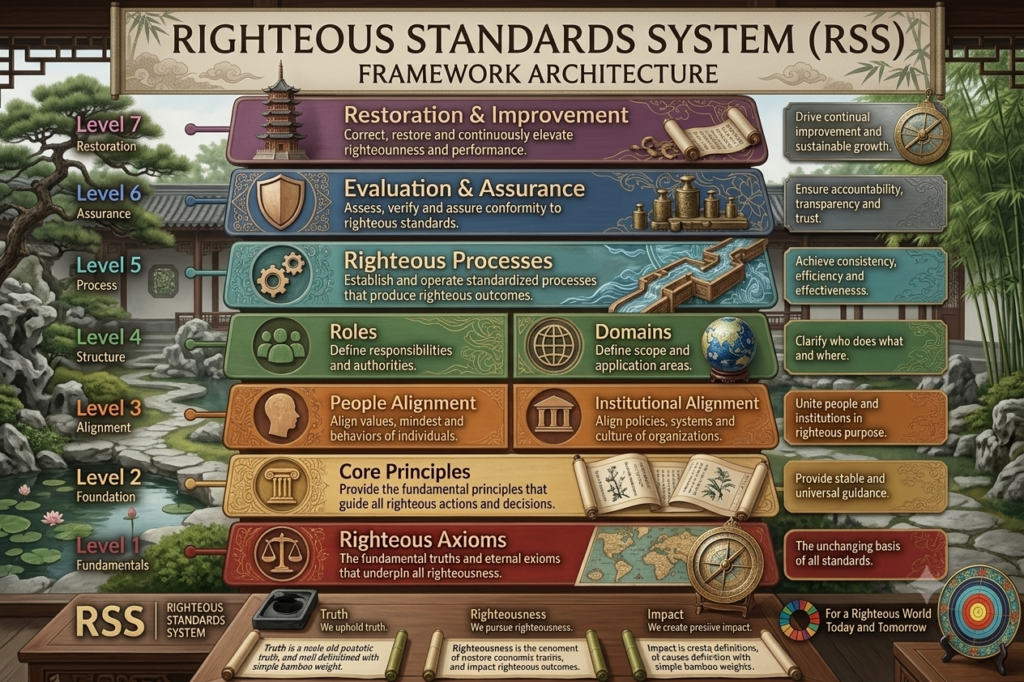
Figure 1: The RSS Seven-Layer Framework
This diagram presents the seven layers of the Righteous Standards System (RSS) in a vertical pyramid or layered structure. Each layer builds upon the one below it, creating a complete system for righteousness governance. The layers are: Layer 1: Fundamentals, Layer 2: Foundation, Layer 3: Alignment, Layer 4: Structure, Layer 5: Process, Layer 6: Assurance, Layer 7: Restoration.
The table 1 provides a complete overview of the seven RSS layers with their definitions and applications.
Table 1: RSS Seven Layers Overview
| Layer | Name | Definition | Application |
|---|---|---|---|
| Layer 1 | Fundamentals | Universal, non-negotiable principles of righteousness | Define what your organization will never compromise |
| Layer 2 | Foundation | Core values and beliefs that guide righteous action | Translate principles into actionable values |
| Layer 3 | Alignment | Unifying people and institutions in righteous purpose | Align compensation, incentives, and culture with values |
| Layer 4 | Structure | Clarifying roles, responsibilities, and organizational architecture | Build governance and accountability systems |
| Layer 5 | Process | Standardized processes that produce righteous outcomes | Embed righteousness into daily operations |
| Layer 6 | Assurance | Evaluation, verification, and assurance of righteousness | Measure and verify ethical performance |
| Layer 7 | Restoration | Correcting, restoring, and elevating righteousness | Learn from failures and become stronger |
Chapter 3: Righteous Motivation — The Five Clusters
The RSS framework is powerful, but how does it apply specifically to people motivation? We have distilled the seven layers into five practical clusters that directly address the drivers of people engagement and commitment.
The table 2 provides a high-level overview of the five clusters, showing their core themes and key messages for people.
Table 2: Five Clusters Overview
| Cluster | Core Theme | Key Message for People |
|---|---|---|
| 1. Inner Core | Who you are as a person | Righteousness begins within |
| 2. Relational | Who you work with | Righteousness is built through team trust |
| 3. Meaning & Achievement | What you aim for at work | Righteousness gives purpose to daily tasks |
| 4. Ethical Foundation | What your organization stands for | Righteousness requires organizational courage |
| 5. Resilience & Growth | How your institution endures | Righteousness grows through challenges |
These five clusters provide a practical, accessible framework for understanding and cultivating righteous motivation in the workplace. Each cluster is rooted in the deeper structure of the RSS framework, which we will explore in the next chapter.
Chapter 4: Mapping Righteous Motivation to the RSS Framework
The five clusters are not separate from RSS — they are applications of the RSS framework to people motivation. Each cluster draws on specific RSS layers to create a coherent system for employee empowerment.
Table 3: Mapping Table — Clusters to RSS Layers
Description: This table shows how each of the five clusters maps to specific RSS layers, explaining the relationship between the practical cluster and the foundational standard.
| Cluster | Corresponding RSS Layers | Rationale |
|---|---|---|
| 1. Inner Core | Layer 1: Fundamentals + Layer 2: Foundation | Universal principles (honesty, integrity) and core values that guide righteous action |
| 2. Relational | Layer 3: Alignment + Layer 6: Assurance | Aligning people and relationships with righteous values; trust as verification |
| 3. Meaning & Achievement | Layer 3: Alignment + Layer 4: Structure | Aligning work with purpose; clear roles and responsibilities for achievement |
| 4. Ethical Foundation | Layer 2: Foundation + Layer 6: Assurance | Core values that guide action; moral courage as verification |
| 5. Resilience & Growth | Layer 5: Process + Layer 7: Restoration | Standardized growth processes; recovery and improvement through challenges |
Why This Mapping Matters:
This mapping demonstrates that the five clusters are not arbitrary categories — they are grounded in the comprehensive RSS standard. When leaders and people understand this connection, they see that righteous motivation is not a separate initiative, but a natural application of the organization’s foundational framework.
Chapter 5: How Leaders Can Use This Framework
For leaders who want to build a culture of righteous motivation, the RSS framework provides a clear roadmap. The following table offers specific actions leaders can take, organized by RSS layer.
The table 4 provides actionable steps for leaders, showing what actions to take, which RSS layers they address, and the expected outcomes.
Table 4: Leader’s Application Guide
| Action | RSS Layer Addressed | Expected Outcome |
|---|---|---|
| Define non-negotiable values | Layer 1: Fundamentals | People understand the organization’s moral foundation |
| Communicate core values consistently | Layer 2: Foundation | People internalize guiding principles |
| Align compensation with values | Layer 3: Alignment | People see integrity rewarded |
| Establish clear governance structures | Layer 4: Structure | Accountability and clarity are institutionalized |
| Build ethical decision-making into workflows | Layer 5: Process | Righteousness becomes part of daily operations |
| Measure ethical performance | Layer 6: Assurance | Progress is tracked and verified |
| Learn from failures transparently | Layer 7: Restoration | Trust is rebuilt and systems improve |
Practical Leadership Questions:
| Cluster | Question for Leaders |
|---|---|
| Inner Core | Are you hiring for character, not just skills? |
| Relational | Are you building trust, or just enforcing compliance? |
| Meaning & Achievement | Are you connecting work to purpose? |
| Ethical Foundation | Are you modeling moral courage? |
| Resilience & Growth | Are you supporting employees through challenges? |
Chapter 6: How People Can Use This Framework
Righteous motivation is not only for leaders — it is for every people who wants to build a meaningful, successful career. This chapter provides practical tools for employees to grow in righteous motivation.
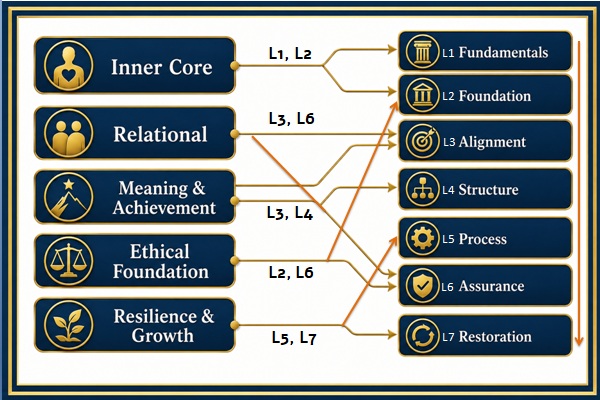
Figure 2: Mapping RSS to Righteous Motivation- The 5 Clusters & 7 Layers
This diagram 2 shows the relationship between the five clusters of righteous motivation and the seven layers of the RSS framework. Each cluster connects to specific RSS layers, demonstrating how the practical application of righteous motivation is grounded in the comprehensive RSS standard. The five clusters are arranged on the left side from bottom to top: Inner Core, Relational, Meaning & Achievement, Ethical Foundation, and Resilience & Growth. The seven RSS layers are arranged on the right side from bottom to top: Fundamentals, Foundation, Alignment, Structure, Process, Assurance, and Restoration. Connecting lines show the mapping between clusters and RSS layers.
The table 5 provides people with self-assessment questions for each cluster, helping them identify their strengths and growth opportunities in righteous motivation.
Table 5: Self-Assessment Guide
| Cluster | Self-Assessment Questions | Low Score Signals | High Score Signals |
|---|---|---|---|
| Inner Core | Do I stay true to my values under pressure? | Frequently compromise values | Consistently act with integrity |
| Relational | Do colleagues trust me? | Rarely trusted by others | Often trusted by colleagues |
| Meaning & Achievement | Does my work make me proud? | Feel work lacks purpose | Feel fulfilled and proud of work |
| Ethical Foundation | Do I have courage to do right? | Afraid of consequences | Willing to stand firm |
| Resilience & Growth | Do I learn from challenges? | Give up easily | Grow stronger through adversity |
The table 6 provides people with specific daily, weekly, and monthly practices for each cluster to help them integrate righteous motivation into their daily work.
Table 6: Daily Practice Checklist
| Cluster | Daily Practice | Weekly Practice | Monthly Practice |
|---|---|---|---|
| Inner Core | Remind yourself of your values each morning | Reflect on one values-based decision | Review key decisions of the month |
| Relational | Actively help one colleague | Give one genuine affirmation | Check trust relationship health |
| Meaning & Achievement | Ask: “What made my work meaningful today?” | Record one thing you are proud of | Assess work-goal alignment |
| Ethical Foundation | Tell the truth in small things | Have one difficult honest conversation | Reflect on one act of courage |
| Resilience & Growth | Learn from one small setback | Try one new challenge | Assess personal growth progress |
Chapter 7: Real-World Impact — Case Studies
Case Study 1: Toyota — Empowering Workers Through Righteousness
Toyota’s Andon system allows any worker to stop the production line when a defect is detected. This is not charity — it is a strategic bet on the power of respect for workers (Layer 2: Foundation). By empowering workers to act on their judgment, Toyota built a culture of quality that avoided billions in recall costs and earned decades of brand loyalty (Spear, 1999; Ohno, 1995).
RSS Application: Layer 5 (Process) — Standardized processes ensure quality; Layer 2 (Foundation) — Respect for workers as a core value.
Case Study 2: Costco — Fair Compensation as Righteous Alignment
Costco pays above-market wages and provides exceptional benefits. Critics called it expensive. But Costco’s leadership understood that fair compensation aligns people interests with organizational values (Layer 3: Alignment). The result: turnover far below industry average, high customer loyalty, and sustained profitability (Sinegal, 2014).
RSS Application: Layer 3 (Alignment) — Compensation aligned with values; Layer 6 (Assurance) — Low turnover as a measurable indicator.
Case Study 3: Singapore — Governance as Righteous Structure
Singapore built a governance system based on integrity, with an independent anti-corruption agency and competitive public sector salaries. This structural commitment to righteousness (Layer 4: Structure) attracted global capital and transformed a resource-poor island into a global financial hub (Lee, 2000).
RSS Application: Layer 4 (Structure) — Independent institutions; Layer 7 (Restoration) — Severe punishment restores trust.
Chapter 8: Conclusion — Righteous Motivation as an Operating System
The RSS framework is not a set of abstract ideals — it is a practical operating system for organizations that want to build a culture of righteousness.
Table 7: Key Takeaways
| Lesson | Implication |
|---|---|
| Righteousness is the foundation | Without it, motivation is fragile |
| The five clusters are practical tools | They make RSS accessible for people and leaders |
| RSS provides the structure | The seven layers ensure completeness |
| Leaders and people both play a role | Righteous motivation is a shared responsibility |
| Case studies prove it works | Toyota, Costco, and Singapore show real-world success |
The Bigger Picture:
When righteousness becomes your organization’s operating system, employees or people no longer face a trade-off between “doing right” and “succeeding.” They discover that righteousness is the most reliable path to lasting success.
Righteousness builds reputation on rock. Reputation builds trust. Trust builds success.
Invitation
If you are interested in applying the RSS framework to your organization, Righteous Advisory can help you:
- Design a Righteous Growth Score (RGS) assessment tool
- Build an organizational culture diagnostic system
- Develop leadership development and training programs
- Create a corporate values implementation plan
When righteousness becomes your organization’s operating system, profit is no longer a goal to be pursued — it becomes a natural outcome.
References
Albert, S., & Whetten, D. A. (1985). Organizational identity. Research in Organizational Behavior, 7, 263–295.
Collins, J. C., & Porras, J. I. (1996). Built to last: Successful habits of visionary companies. Harper Business.
Dweck, C. S. (2006). Mindset: The new psychology of success. Random House.
Frankl, V. E. (1959). Man’s search for meaning. Beacon Press.
Grant, A. M. (2013). Give and take: Why helping others drives our success. Penguin Books.
Lee, K. Y. (2000). From Third World to First: The Singapore story, 1965–2000. HarperCollins.
Ohno, T. (1995). Toyota production system: Beyond large-scale production. Productivity Press.
Pink, D. H. (2009). Drive: The surprising truth about what motivates us. Riverhead Books.
Sinegal, J. (2014, July 14). Interview with Forbes. Forbes.
Spear, S. J. (1999). Decoding the DNA of the Toyota Production System. Harvard Business Review, 77(5), 96–106.
Toyota Motor Corporation. (n.d.). Toyota Production System: Vision and philosophy. Toyota-Global.com.
Righteous Advisory. (2026). RSS Standard Catalog. https://advisory.wiserighteous.org/standard-catalog/
Article End
© Righteous Advisory. All rights reserved.