
Version: v1.0
Last Updated: Q3 2026
Status: Active

The Righteous Index for Organization Employee (RI-OE) is a standardized measurement tool designed to assess an employee‘s current state of righteousness within an organizational context. Built upon the Righteous Standards System (RSS), RI-OE provides a clear, multi‑source picture of where an employee stands across 7 dimensions — combining self‑assessment with evaluations from managers, peers, and subordinates. This document provides a comprehensive guide to RI-OE, including its 7 dimensions, assessment sources, questionnaire structure, scoring methodology, and practical applications for employee development and coaching.
Table of Contents
| Section | Title |
|---|---|
| 1 | Overview of RI-OE |
| 1.1 | What Is RI-OE? |
| 1.2 | Purpose and Applications |
| 1.3 | Who Should Use RI-OE? |
| 2 | The 7 Dimensions of RI-OE |
| 2.1 | Dimension 1: Fundamentals |
| 2.2 | Dimension 2: Foundation |
| 2.3 | Dimension 3: Alignment |
| 2.4 | Dimension 4: Structure |
| 2.5 | Dimension 5: Process |
| 2.6 | Dimension 6: Assurance |
| 2.7 | Dimension 7: Restoration |
| 3 | RI-OE Assessment Sources |
| 3.1 | Self‑Assessment |
| 3.2 | Manager Assessment |
| 3.3 | Peer Assessment |
| 3.4 | Subordinate Assessment |
| 3.5 | Aggregated Multi‑Source Scoring |
| 4 | RI-OE Questionnaire Structure |
| 4.1 | Question Format |
| 4.2 | Sample Questions by Dimension |
| 4.3 | RSS Measurement Aspects for RI-OE |
| 5 | RI-OE Scoring Methodology |
| 5.1 | Scoring Overview |
| 5.2 | Dimension Weighting |
| 5.3 | Score Calculation |
| 5.4 | Score Interpretation |
| 6 | Using RI-OE for Employee Development |
| 6.1 | Assessment Process |
| 6.2 | Creating a Development Plan |
| 6.3 | Tracking Progress Over Time |
| 7 | RI-OE in the Broader Ecosystem |
| 7.1 | Relationship to RSS |
| 7.2 | Relationship to RI-I |
| 7.3 | Relationship to RI-O |
| 7.4 | Relationship to RMF and RGS |
| 8 | Frequently Asked Questions |
| Appendix | Reference Tables |
| A | RI-OE Dimension Summary |
| B | RI-OE Sample Report |
| C | RI-OE Version History |
| References |
1. Overview of RI-OE
1.1 What Is RI-OE?
RI-OE (Righteous Index for Organization Employee) is a standardized measurement tool designed to assess an employee’s current state of righteousness within an organizational context. It is directly based on the Righteous Standards System (RSS) , which defines righteousness through 7 interdependent layers.
Unlike RI-I (which is purely self‑assessment), RI-OE is a multi‑source assessment that combines:
- Self‑Assessment (the employee‘s own perception)
- Manager Assessment (evaluation by the employee’s direct supervisor)
- Peer Assessment (evaluation by colleagues at a similar level)
- Subordinate Assessment (evaluation by direct reports — if applicable)
RI-OE provides a 360‑degree view of an employee‘s righteous health in the workplace, helping identify blind spots, strengths, and development areas from multiple perspectives.
RI-OE is not a performance evaluation — it is a development tool for growth.
1.2 Purpose and Applications
RI-OE serves multiple purposes for employees and organizations seeking to grow in righteousness:
Table 1: RI-OE Purpose and Applications
| Application | Description |
|---|---|
| Development Planning | Identify specific areas for employee growth and development |
| Coaching & Mentoring | Provide a structured framework for development conversations |
| Leadership Development | Build self‑awareness and intentional growth in integrity and leadership |
| Talent Management | Support succession planning and career development |
| Organizational Culture | Identify patterns and trends across teams and departments (when aggregated) |
| Feedback Culture | Promote a culture of constructive, multi‑source feedback |
Description: This table outlines the primary applications of RI-OE for employees and organizations.
1.3 Who Should Use RI-OE?
RI-OE is designed for:
Table 2: RI-OE Target Users
| User Type | How They Use RI-OE |
|---|---|
| Employees | Understand their own righteous state from multiple perspectives |
| Managers | Support employee development and provide constructive feedback |
| HR Professionals | Support talent development and leadership programs |
| Coaches & Mentors | Provide structured development conversations |
| Organizations | Diagnose culture patterns and identify development needs across teams |
Description: This table identifies the primary users of RI-OE and how they benefit from it.
2. The 7 Dimensions of RI-OE
RI-OE is built on the Righteous Standards System (RSS) , which defines righteousness through 7 interdependent layers. Each layer corresponds to a dimension of RI-OE.
2.1 Dimension 1: Fundamentals
Corresponds to RSS Layer 1: Fundamentals
This dimension measures the employee’s commitment to universal principles of honesty, respect, fairness, and responsibility in the workplace.
Table 3: Fundamentals — What It Measures
| Aspect | What It Measures |
|---|---|
| Values Clarity | How clearly the employee knows what they stand for at work |
| Integrity | How consistently their actions align with their stated values |
| Dignity | How they value themselves and others in the workplace |
| Authenticity | How true they are to who they are in a professional context |
Description: This table breaks down the key aspects of the Fundamentals dimension.
2.2 Dimension 2: Foundation
Corresponds to RSS Layer 2: Foundation
This dimension measures the depth of the employee’s core values and beliefs that guide righteous action at work.
Table 4: Foundation — What It Measures
| Aspect | What It Measures |
|---|---|
| Groundedness | How stable and rooted the employee is in their values at work |
| Self‑Mastery | Their ability to discipline themselves and stay true to their convictions |
| Consistency | How consistently they apply their values across different work situations |
Description: This table breaks down the key aspects of the Foundation dimension.
2.3 Dimension 3: Alignment
Corresponds to RSS Layer 3: Alignment
This dimension measures the consistency between the employee‘s values, actions, and workplace relationships.
Table 5: Alignment — What It Measures
| Aspect | What It Measures |
|---|---|
| Trustworthiness | How reliably they follow through on work commitments |
| Respect | How they treat colleagues with dignity and fairness |
| Connection | How deeply they connect with others at work |
| Belonging | How much they feel part of a meaningful team or community |
Description: This table breaks down the key aspects of the Alignment dimension.
2.4 Dimension 4: Structure
Corresponds to RSS Layer 4: Structure
This dimension measures the employee‘s sense of purpose, contribution, and accomplishment in their role.
Table 6: Structure — What It Measures
| Aspect | What It Measures |
|---|---|
| Purpose | How clearly they understand their “why” at work |
| Contribution | How much they feel they are making a difference |
| Achievement | How proud they are of what they accomplish |
| Progress | How much they see themselves growing professionally |
Description: This table breaks down the key aspects of the Structure dimension.
2.5 Dimension 5: Process
Corresponds to RSS Layer 5: Process
This dimension measures the employee‘s ability to persevere, learn, and grow through workplace challenges.
Table 7: Process — What It Measures
| Aspect | What It Measures |
|---|---|
| Resilience | How quickly they bounce back from work setbacks |
| Learning | How well they learn from mistakes |
| Adaptability | How flexibly they respond to change at work |
| Perseverance | How consistently they persist through difficulty |
Description: This table breaks down the key aspects of the Process dimension.
2.6 Dimension 6: Assurance
Corresponds to RSS Layer 6: Assurance
This dimension measures the employee‘s willingness to stand firm and act with integrity under workplace pressure.
Table 8: Assurance — What It Measures
| Aspect | What It Measures |
|---|---|
| Moral Courage | How willing they are to do what is right at work, even when it costs them |
| Honesty | How truthful they are with themselves and others in the workplace |
| Speaking Up | How readily they speak up when they see something wrong |
| Accountability | How they take responsibility for their work actions |
Description: This table breaks down the key aspects of the Assurance dimension.
2.7 Dimension 7: Restoration
Corresponds to RSS Layer 7: Restoration
This dimension measures the employee‘s ability to recover, learn, and improve from workplace failures.
Table 9: Restoration — What It Measures
| Aspect | What It Measures |
|---|---|
| Recovery | How quickly they recover from professional setbacks |
| Learning from Failure | How well they learn from work mistakes |
| Restoration | How they restore trust and relationships after workplace failures |
Description: This table 9 breaks down the key aspects of the Restoration dimension.
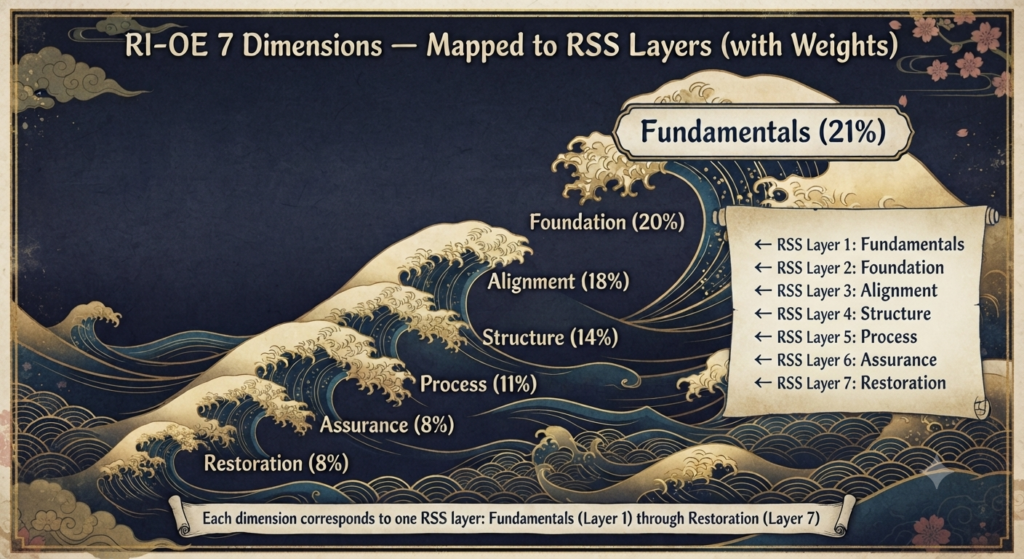
Figure 1: RI-OE 7 Dimensions — Mapped to RSS Layers (with Weights)
Description: This horizontal bar chart displays the 7 dimensions of RI-OE, each mapped to a corresponding RSS layer. The length of each bar represents the dimension’s consensus weight, showing the relative importance of each dimension in calculating the overall RI-OE score.
3. RI-OE Assessment Sources
RI-OE is a multi‑source assessment that combines feedback from multiple perspectives.
3.1 Self‑Assessment
The employee evaluates their own state of righteousness across the 7 dimensions.
Table 10: Self‑Assessment Overview
| Aspect | Description |
|---|---|
| Source | Employee |
| Purpose | Understand their own perception of their righteous state |
| Benefit | Identifies self‑awareness gaps and blind spots |
3.2 Manager Assessment
The employee‘s direct supervisor evaluates the employee’s state of righteousness.
Table 11: Manager Assessment Overview
| Aspect | Description |
|---|---|
| Source | Direct Supervisor |
| Purpose | Provide an external leadership perspective |
| Benefit | Identifies how leadership perceives the employee‘s righteous behavior |
3.3 Peer Assessment
Colleagues at a similar level evaluate the employee’s state of righteousness.
Table 12: Peer Assessment Overview
| Aspect | Description |
|---|---|
| Source | Peers (3–5 colleagues) |
| Purpose | Provide a horizontal perspective from team members |
| Benefit | Identifies how teammates perceive the employee‘s trustworthiness and collaboration |
3.4 Subordinate Assessment
Direct reports evaluate the employee’s state of righteousness (if applicable).
Table 13: Subordinate Assessment Overview
| Aspect | Description |
|---|---|
| Source | Direct Reports (if applicable) |
| Purpose | Provide a downward leadership perspective |
| Benefit | Identifies how the employee is perceived as a leader |
3.5 Aggregated Multi‑Source Scoring
Each assessment source produces a separate score across the 7 dimensions. The final RI-OE score can be calculated in different ways:
Description: This table 10 outlines the different methods for aggregating multi‑source scores in RI-OE.
Table 14: RI-OE Aggregation Methods
| Method | Description | When to Use |
|---|---|---|
| Self‑Only | Only self‑assessment score | Personal reflection, coaching conversations |
| Average (All Sources) | Average of self + manager + peers + subordinates | Balanced view of all perspectives |
| Weighted Average | Assign different weights to each source (e.g., 50% self + 50% others) | When certain sources are more valued |
| Gap Analysis | Compare self score vs. average of others | Identify blind spots and self‑awareness gaps |
Note: RI-OE v1.0 recommends using the Average (All Sources) method for the final score, with optional reporting of individual source scores for development conversations.
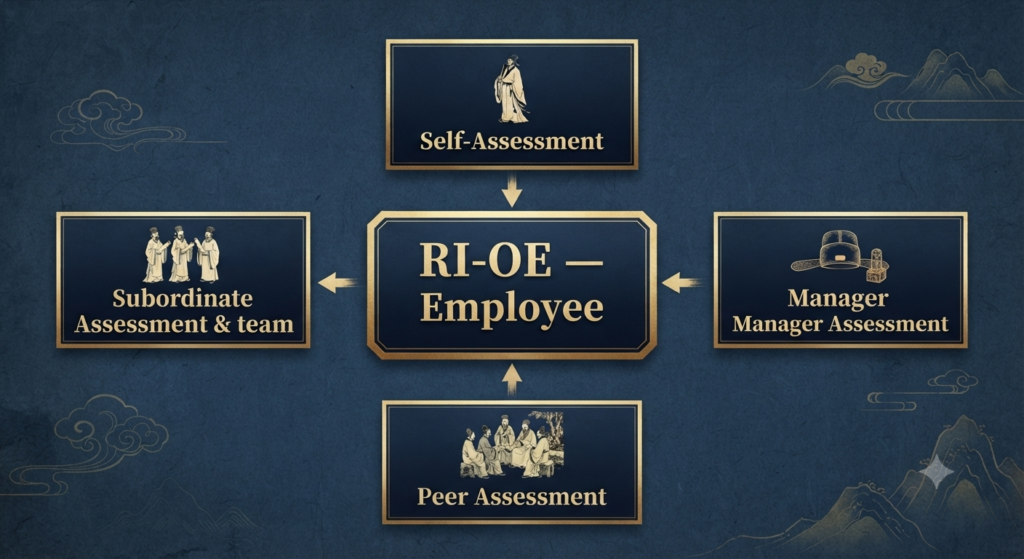
Figure 2: RI-OE Multi‑Source Assessment Model
Description: This diagram illustrates the four assessment sources that contribute to an RI-OE score — Self, Manager, Peers, and Subordinates — converging on the employee.
4. RI-OE Questionnaire Structure
4.1 Question Format
RI-OE uses a 5‑point Likert scale for each question, consistent across all assessment sources.
Table 15: RI-OE Response Scale
| Score | Label | Meaning |
|---|---|---|
| 5 | Strongly Agree | Consistently true in my experience |
| 4 | Agree | Mostly true in my experience |
| 3 | Neutral | Neither true nor false in my experience |
| 2 | Disagree | Mostly false in my experience |
| 1 | Strongly Disagree | Consistently false in my experience |
Description: This table defines the 5‑point Likert scale used in the RI-OE questionnaire.
4.2 Sample Questions by Dimension
Table 16: RI-OE Sample Questions
| Dimension | Sample Questions |
|---|---|
| Fundamentals | The employee stays true to their values even under workplace pressure. The employee is honest even when it is difficult. The employee treats others with dignity and respect. The employee is authentic in how they present themselves. |
| Foundation | The employee has a clear sense of what they stand for at work. The employee has the discipline to stay true to their convictions. The employee is consistent in how they apply their values. |
| Alignment | The employee follows through on commitments reliably. The employee treats colleagues with respect and fairness. The employee feels a genuine sense of belonging in the team. |
| Structure | The employee‘s work gives them a sense of purpose. The employee feels they are making a meaningful contribution. The employee is proud of what they accomplish. |
| Process | The employee bounces back from setbacks quickly. The employee learns from their mistakes. The employee adapts well to change. |
| Assurance | The employee speaks up when they see something wrong. The employee takes responsibility for their actions. The employee acts with integrity even when no one is watching. |
| Restoration | The employee recovers from failures and setbacks. The employee learns from their failures. The employee works to restore trust after mistakes. |
Description: This table provides example questions for each of the 7 RI-OE dimensions.
4.3 RSS Measurement Aspects for RI-OE
RI-OE questionnaire is designed based on the 7 layers of the Righteous Standards System (RSS) .
Table 17: RSS Measurement Aspects by RI-OE Dimension
| RSS Layer | RI-OE Dimension | Measurement Aspects |
|---|---|---|
| Layer 1: Fundamentals | Fundamentals | Values Clarity, Integrity, Dignity, Authenticity |
| Layer 2: Foundation | Foundation | Groundedness, Self‑Mastery, Consistency |
| Layer 3: Alignment | Alignment | Trustworthiness, Respect, Connection, Belonging |
| Layer 4: Structure | Structure | Purpose, Contribution, Achievement, Progress |
| Layer 5: Process | Process | Resilience, Learning, Adaptability, Perseverance |
| Layer 6: Assurance | Assurance | Moral Courage, Honesty, Speaking Up, Accountability |
| Layer 7: Restoration | Restoration | Recovery, Learning from Failure, Restoration |
Description: This table shows how each RSS layer maps to an RI-OE dimension and the corresponding measurement aspects used for questionnaire design.
Note: These measurement aspects are the same as RI-I, but the questions are worded to reflect workplace and organizational context.
5. RI-OE Scoring Methodology
5.1 Scoring Overview
RI-OE uses a weighted scoring methodology to calculate a single overall score (0–100) that reflects the employee‘s current state of righteousness in the workplace.
Table 18: RI-OE Scoring Overview
| Component | Description |
|---|---|
| Data Source | RI-OE multi‑source questionnaire responses (5‑point Likert scale) |
| Core Dimensions | 7 dimensions (mapped to RSS layers) |
| Score Range | 0 – 100 |
| Calculation | Weighted sum of dimension scores |
| Aggregation | Average of all assessment sources (self + manager + peers + subordinates) |
| Version Control | Semantic versioning (v1.0, v2.0, etc.) |
Description: This table summarizes the key components of RI-OE scoring.
5.2 Dimension Weighting
Table 19: RI-OE Dimension Weights (v1.0)
| Dimension | Weight | Rationale |
|---|---|---|
| Fundamentals | 21% | The foundation of all workplace righteousness — commitment to universal principles anchors every other dimension |
| Foundation | 20% | Core values and beliefs that guide all righteous workplace action |
| Alignment | 18% | Consistency between values, actions, and workplace relationships — integrity in motion |
| Structure | 14% | Purpose, contribution, and achievement — the architectural framework for righteous work |
| Process | 11% | Resilience, learning, adaptability, and perseverance — sustaining righteousness through workplace challenges |
| Assurance | 8% | Moral courage, honesty, speaking up, and accountability — the “stress‑test” dimension |
| Restoration | 8% | Recovery, learning from failure, and restoring relationships — episodic but essential for long‑term growth |
This table 15 shows the consensus weights for each of the 7 RI-OE dimensions. These weights are derived from averaging the recommendations of four independent expert sources (ChatGPT, Gemini, Copilot, and internal baseline), using the same consensus process established for RI-I.
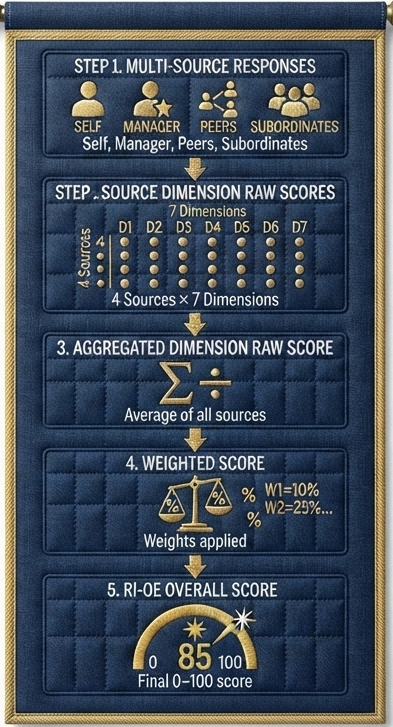
Figure 3: RI-OE Score Calculation Flow
5.3 Score Calculation
Step 1: Calculate Source Scores
For each assessment source (self, manager, peers, subordinates), calculate the average score for each dimension across all questions in that dimension.
Dimension Raw Score (Source) = (Sum of all question scores in that dimension from that source) / (Number of questions)Step 2: Aggregate Scores Across Sources
Calculate the average of all source scores for each dimension.
Dimension Raw Score (Aggregated) = Average of (Self Score + Manager Score + Peer Score + Subordinate Score)Step 3: Calculate Dimension Weighted Score
Multiply the aggregated raw score by its weight.
Dimension Weighted Score = Dimension Raw Score (Aggregated) × Dimension WeightStep 4: Calculate Overall RI-OE Score
Sum all dimension weighted scores and convert to a 0–100 scale.
RI-OE Score = (Sum of all dimension weighted scores) × 20Example:
| Dimension | Self | Manager | Peers | Subordinates | Aggregated Raw | Weight | Weighted |
|---|---|---|---|---|---|---|---|
| Fundamentals | 4.33 | 4.00 | 4.25 | 4.50 | 4.27 | 21% | 0.897 |
| Foundation | 3.80 | 3.80 | 3.75 | 3.90 | 3.81 | 20% | 0.762 |
| Alignment | 3.50 | 3.40 | 3.60 | 3.70 | 3.55 | 18% | 0.639 |
| Structure | 4.50 | 4.20 | 4.00 | 4.10 | 4.20 | 14% | 0.588 |
| Process | 3.20 | 3.10 | 3.30 | 3.40 | 3.25 | 11% | 0.358 |
| Assurance | 2.90 | 3.00 | 3.10 | 3.20 | 3.05 | 8% | 0.244 |
| Restoration | 3.10 | 3.00 | 3.20 | 3.30 | 3.15 | 8% | 0.252 |
| Total | 100% | 3.740 |
RI-OE Score = 3.740 × 20 = 74.80 → 755.4 Score Interpretation
Table 20: RI-OE Score Interpretation
| Score Range | Rating | Description | Recommended Action |
|---|---|---|---|
| 86 – 100 | Exemplary | Consistently demonstrates workplace righteousness; a role model for others | Continue to maintain; consider mentoring others |
| 71 – 85 | Proficient | Solid foundation; demonstrates workplace righteousness consistently | Identify specific areas for refinement |
| 51 – 70 | Developing | Foundational elements present; significant growth opportunities exist | Prioritize 1–2 dimensions for focused development |
| 0 – 50 | Emerging | Needs attention and development across multiple dimensions | Begin with foundational dimensions (Fundamentals, Foundation) |
Description: This table provides guidance on interpreting RI-OE scores, including recommended actions for each score range.
6. Using RI-OE for Employee Development
6.1 Assessment Process
Table 21: RI-OE Assessment Process
| Step | Action | Description |
|---|---|---|
| 1 | Complete Multi‑Source Questionnaire | Employee, manager, peers, and subordinates complete the RI-OE questionnaire |
| 2 | Receive Your RI-OE Score | Get the overall score and dimension scores (aggregated and by source) |
| 3 | Review Your Results | Understand strengths, growth areas, and blind spots (self vs. others) |
| 4 | Identify Priorities | Select 1–2 dimensions for focused development |
| 5 | Create a Development Plan | Develop specific goals and action steps |
| 6 | Track Your Progress | Re‑assess in 6–12 months using RGS |
Description: This table outlines the step‑by‑step process for completing the RI-OE assessment.
6.2 Creating a Development Plan
Table 22: RI-OE Development Plan Template — Sample
| Dimension | Score | Priority (Y/N) | Goal | Action Steps | Target Date |
|---|---|---|---|---|---|
| Fundamentals | 82 | N | Maintain this strength | Continue journaling on values; mentor others on integrity | Ongoing |
| Foundation | 75 | N | Build on existing foundation | Deepen self‑reflection practices | 3 months |
| Alignment | 65 | Y | Improve consistency between words and actions | Practice speaking up more; seek feedback from peers | 6 months |
| Structure | 88 | N | Sustain high purpose | Lead a purpose‑driven project | 6 months |
| Process | 68 | Y | Build resilience | Read one book on resilience; learn from one setback per week | 3 months |
| Assurance | 72 | N | Maintain ethical courage | Continue to speak up when needed | Ongoing |
| Restoration | 70 | Y | Develop recovery habits | Create a personal recovery plan after setbacks | 6 months |
Description: This table provides a completed example of an RI-OE development plan using sample scores and goals.
6.3 Tracking Progress Over Time
Table 23: RI-OE Progress Tracking
| Assessment Date | RI-OE Score | Change | Note |
|---|---|---|---|
| Initial (T1) | 68 | — | Baseline |
| 6 Months (T2) | 72 | +4 | Small improvement |
| 12 Months (T3) | 78 | +6 | Continued growth |
| 18 Months (T4) | 82 | +4 | Maintained improvement |
Description: This table illustrates how RI-OE scores can be tracked over time to measure growth.
7. RI-OE in the Broader Ecosystem
7.1 Relationship to RSS
RI-OE is directly based on the Righteous Standards System (RSS) .
Table 24: RI-OE Dimensions Mapped to RSS Layers
| RSS Layer | RI-OE Dimension |
|---|---|
| Layer 1: Fundamentals | Fundamentals |
| Layer 2: Foundation | Foundation |
| Layer 3: Alignment | Alignment |
| Layer 4: Structure | Structure |
| Layer 5: Process | Process |
| Layer 6: Assurance | Assurance |
| Layer 7: Restoration | Restoration |
Description: This table shows how each RI-OE dimension maps to an RSS layer.
7.2 Relationship to RI-I
RI-OE and RI-I share the same 7 dimensions but differ in assessment approach:
Table 25: RI-I vs. RI-OE — Comparison
| Aspect | RI-I | RI-OE |
|---|---|---|
| Assessment | Self‑only | Multi‑source (self + manager + peers + subordinates) |
| Context | General life | Workplace |
| Purpose | Personal growth | Employee development and leadership growth |
RI-OE can be seen as the workplace extension of RI-I.
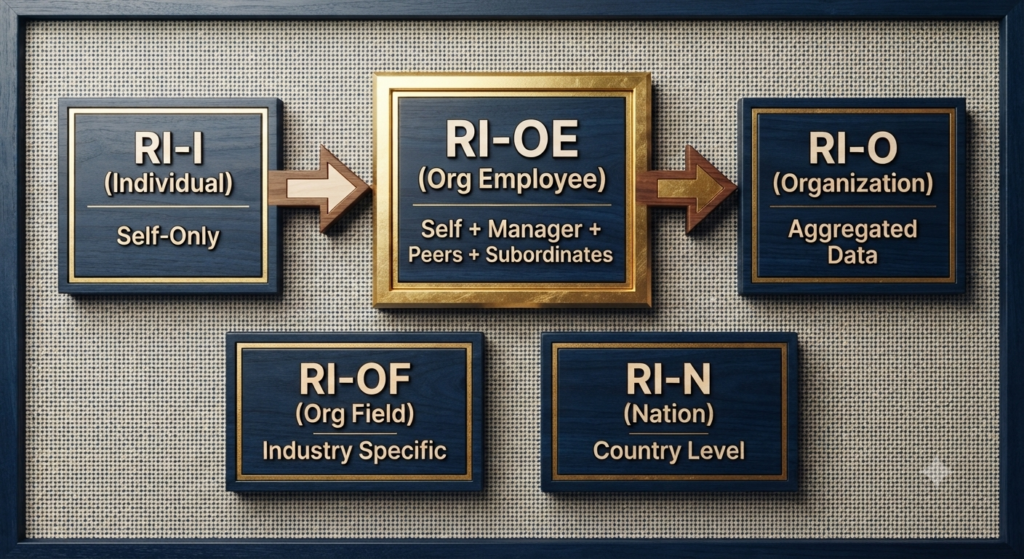
Figure 4: RI-OE in the RI Family — Role and Position
This diagram illustrates the position of RI-OE within the RI family, showing its relationship to RI-I, RI-O, RI-OF, and RI-N. RI-OE serves as the organizational employee version, bridging individual self‑assessment (RI-I) and organizational-level assessment (RI-O).
7.3 Relationship to RI-O
RI-O (Organizational version) uses aggregated RI-OE data as input:
RI-OE (Employee) → Aggregated → RI-O (Organization)RI-O represents the collective righteous health of the organization.
7.4 Relationship to RMF and RGS
Table 26: RMF vs. RI-RGS — Comparison
| Tool | Role |
|---|---|
| RMF | Diagnoses motivation gaps that may explain low RI-OE scores |
| RGS | Tracks RI-OE growth over time: RGS = RI-OE(T2) — RI-OE(T1) |
8. Frequently Asked Questions
Table 27: RI-OE Frequently Asked Questions
| Question | Answer |
|---|---|
| How long does it take to complete RI-OE? | Approximately 15–20 minutes per source. |
| How many peers should provide feedback? | Recommended 3–5 peers. |
| Is subordinate feedback required? | Only if the employee has direct reports. |
| How often should I take RI-OE? | Recommended every 6–12 months to track growth. |
| What is the difference between RI-OE and RI-I? | RI-I is self‑only for personal growth; RI-OE is multi‑source for workplace development. |
| Is RI-OE confidential? | Individual RI-OE results are confidential and only shared with the employee and their coach/manager (with permission). Aggregated data may be used for organizational analysis. |
| Can RI-OE be used for performance evaluation? | No — RI-OE is designed for development purposes only, not for performance evaluation or compensation decisions. |
Description: This table provides answers to common questions about RI-OE.
Appendix — Reference Tables
Table A: RI-OE Dimension Summary
| Dimension | Corresponding RSS Layer | Weight | Key Focus |
|---|---|---|---|
| Fundamentals | Layer 1 | 21% | Universal principles, values, integrity, authenticity |
| Foundation | Layer 2 | 20% | Core values, groundedness, self‑mastery, consistency |
| Alignment | Layer 3 | 18% | Trustworthiness, respect, connection, belonging |
| Structure | Layer 4 | 14% | Purpose, contribution, achievement, progress |
| Process | Layer 5 | 11% | Resilience, learning, adaptability, perseverance |
| Assurance | Layer 6 | 8% | Moral courage, honesty, speaking up, accountability |
| Restoration | Layer 7 | 8% | Recovery, learning from failure, restoration |
Description: This table provides a quick reference for all 7 RI-OE dimensions.
Table B: RI-OE Sample Report
| Dimension | Self | Manager | Peers | Subordinates | Aggregated Score | Rating |
|---|---|---|---|---|---|---|
| Fundamentals | 82 | 80 | 85 | 88 | 84 | Proficient |
| Foundation | 75 | 70 | 72 | 78 | 74 | Proficient |
| Alignment | 65 | 60 | 68 | 72 | 66 | Developing |
| Structure | 88 | 85 | 82 | 84 | 85 | Exemplary |
| Process | 68 | 65 | 70 | 72 | 69 | Developing |
| Assurance | 72 | 70 | 75 | 78 | 74 | Proficient |
| Restoration | 70 | 65 | 72 | 75 | 71 | Proficient |
Overall RI-OE Score: 74 — Proficient
Strengths: Structure (85), Fundamentals (84)
Growth Areas: Alignment (66), Process (69)
Blind Spot: Self vs. Others gap in Alignment (Self: 65 vs. Others: ~67)
Description: This table provides a sample RI-OE report showing scores across all 7 dimensions from each source.
Table C: RI-OE Version History
| Version | Release Date | Key Changes |
|---|---|---|
| v1.0 | Q3 2026 | Initial release |
| v1.1 | Q1 2027 | Refined questions; improved weighting |
| v2.0 | Q4 2027 | New dimensions; enhanced predictive validity |
Description: This table documents the release history and key changes for RI-OE.
References
Deci, E. L., & Ryan, R. M. (2000). The “what” and “why” of goal pursuits: Human needs and the self‑determination of behavior. Psychological Inquiry, 11(4), 227–268.
Likert, R. (1932). A technique for the measurement of attitudes. Archives of Psychology, 22(140), 1–55.
Nunnally, J. C., & Bernstein, I. H. (1994). Psychometric theory (3rd ed.). McGraw‑Hill.
Righteous Advisory. (2026). RSS Standard Catalog. https://advisory.wiserighteous.org/standard‑catalog/
Spear, S. J. (1999). Decoding the DNA of the Toyota Production System. Harvard Business Review, 77(5), 96–106.
RI-OE: Measure. Develop. Grow.