
When “Stopping” Drives Growth: The Toyota Production System and the Dignity of the Worker
Metadata
| Field | Content |
|---|---|
| Industry | Corporate / Manufacturing |
| Primary RSS Layer | Layer 5: Process — Standardized processes ensure righteous outcomes |
| Secondary RSS Layer | Layer 2: Foundation — Respect for workers as a core value |
| Related Pillars | Integrity . Right Judgment |
| Core Theme | Worker Dignity . Quality Management . Industrial Ethics |
Context
For much of the 20th century, industrial logic rested on a single, unyielding equation: machine uptime equals profitability. Idle production lines were considered the cardinal sin of operations management. Yet, emerging from post-war Japan, Toyota Motor Corporation introduced a paradigm that fundamentally inverted this calculus—one that treated the authority of the frontline worker not as a liability to productivity, but as its most critical safeguard.
The Toyota Production System (TPS) was largely created by three men: Sakichi Toyoda, founder of the Toyota Group; his son Kiichiro Toyoda; and engineer Taiichi Ohno (Ohno, 1995; Toyota Motor Corporation, n.d.-a). The main goal of the TPS is the complete elimination of waste—known in Japanese as muda—in pursuit of the most efficient methods of production (Ohno, 1995). Yet within this relentless pursuit of efficiency lies a paradox: Toyota’s most powerful tool for eliminating waste is the permission to stop.
The Operational Tension
The central tension in high-volume manufacturing is the trade-off between velocity and quality. Accelerate production, and defects slip through; slow down to inspect, and unit costs rise. By the 1960s, as Toyota scaled its operations, leadership recognized that traditional quality-control checkpoints—inspecting at the end of the line—were insufficient and financially catastrophic. A single undetected defect could cascade into massive recalls, eroding consumer trust and incurring billions in liabilities (Spear, 1999).
The dilemma was existential: How does an organization embed a zero-defect culture without sacrificing the industrial speed required to compete globally?
The Mechanism: Jidoka and the Andon Cord
Toyota’s solution lies in a radical socio-technical principle known as Jidoka —which Toyota defines as “automation with a human touch,” where human wisdom is added to automation (Toyota Motor Corporation, n.d.-b). The term jidoka in the TPS can be defined as “automation with a human touch”—rather than ignoring problems and plowing ahead mindlessly, Toyota assembly lines are designed to stop themselves so that higher-order thinking can be applied to better understand and address the problem before production is resumed (HBR, 2016).
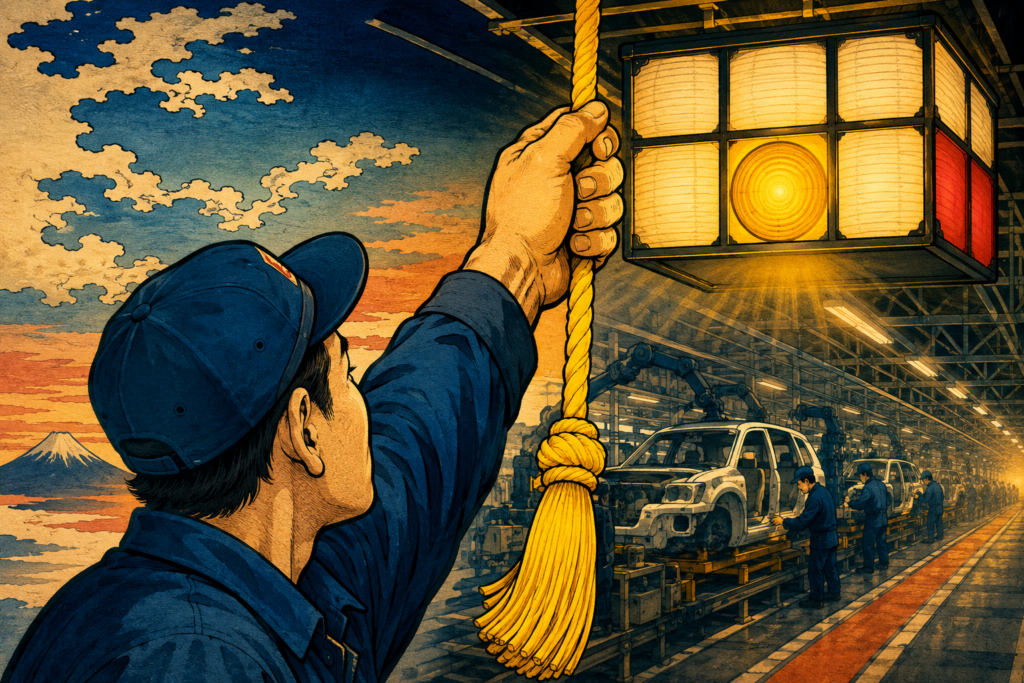
In practice, Jidoka manifests through the Andon system: a physical pull-cord—or, since 2014, increasingly a button—installed at every workstation (Wikipedia, n.d.). The word Andon is a loanword from Japanese, originally meaning “paper lantern” (Wikipedia, n.d.). Toyota’s use of the Andon system dates back to 1950, and it was incorporated into the TPS, a philosophy that governs production in Toyota facilities to this day (Toyota Motor UK, 2017).
The rule is stark and non-negotiable: any line worker, regardless of seniority, possesses the unequivocal authority to halt the entire production line the moment they detect an anomaly in quality (Toyota Motor UK, 2017). As Toyota notes, when an abnormality occurs—whether a machine or equipment abnormality, quality abnormality, or work delay—the operator can stop the line by pulling the stop cord themselves (Toyota Motor Corporation, n.d.-b).
This is not a symbolic gesture of empowerment; it is a rigidly enforced operational mandate. When the cord is pulled, the line stops. Supervisors rush to the workstation. The problem is diagnosed and solved collaboratively at its source—before a single defective unit proceeds downstream (Toyota Motor UK, 2017).
The table 1 illustrates the four standardized steps following the activation of Toyota’s Andon system, clarifying the action and responsible party at each stage. It demonstrates how “quality” is embedded into the production process through a clear, repeatable protocol.
Table 1: The Andon Cord Process — Four-Stage Stop Mechanism
| Step | Action | Responsible Party |
|---|---|---|
| 1 | Worker detects quality anomaly | Frontline worker |
| 2 | Pulls Andon cord; production line stops immediately | Frontline worker |
| 3 | Supervisor and engineers rush to diagnose the problem | Team leader + Engineers |
| 4 | Problem resolved; production line resumes | Team collaboration |
The Financial Calculus: Short-Term Loss vs. Long-Term Premium
To the external observer, stopping a 1,000-vehicle-per-day assembly line appears fiscally irresponsible. The immediate loss in production volume is quantifiable and painful. However, Toyota’s actuarial reasoning reveals a deeper strategic logic.
“Even though potentially stopping the entire production line seems like a costly measure—both in terms of time and productivity—identifying the root cause of the problem allows the issue to be eliminated and the manufacturing process improved. In the long term, this saves time and ensures high quality is delivered to the customer.” (Toyota Motor UK, 2017)
By absorbing the marginal cost of a line-stop, Toyota systematically avoided the exponential costs of mass recalls, litigation, and reputational collapse. Toyota’s recalls have historically cost the company billions—one recall alone cost more than US$2 billion (RNZ, n.d.), and the company has paid record fines of US$1.2 billion in the auto sector (Global Legal Post, 2026). The Andon system represents an investment in preventing such catastrophic costs before they materialize.
This table 2 compares the short-term and long-term impacts of two quality management approaches. It clearly reveals the strategic logic of Toyota’s method—accepting short-term production loss to secure long-term brand value and avoid catastrophic recall costs.
Table 2: Cost-Benefit Analysis of Line Stoppage
| Comparison Dimension | Traditional Method (End-of-line Inspection) | Toyota Method (Real-time Stop) |
|---|---|---|
| Short-term Cost | Low (no line stoppage) | High (immediate production loss) |
| Long-term Risk | High (mass recalls, brand collapse) | Low (defects contained at source) |
| Employee Role | Passive execution | Active guardian |
| Brand Value | Eroded | Accumulates “Reliability Premium” |
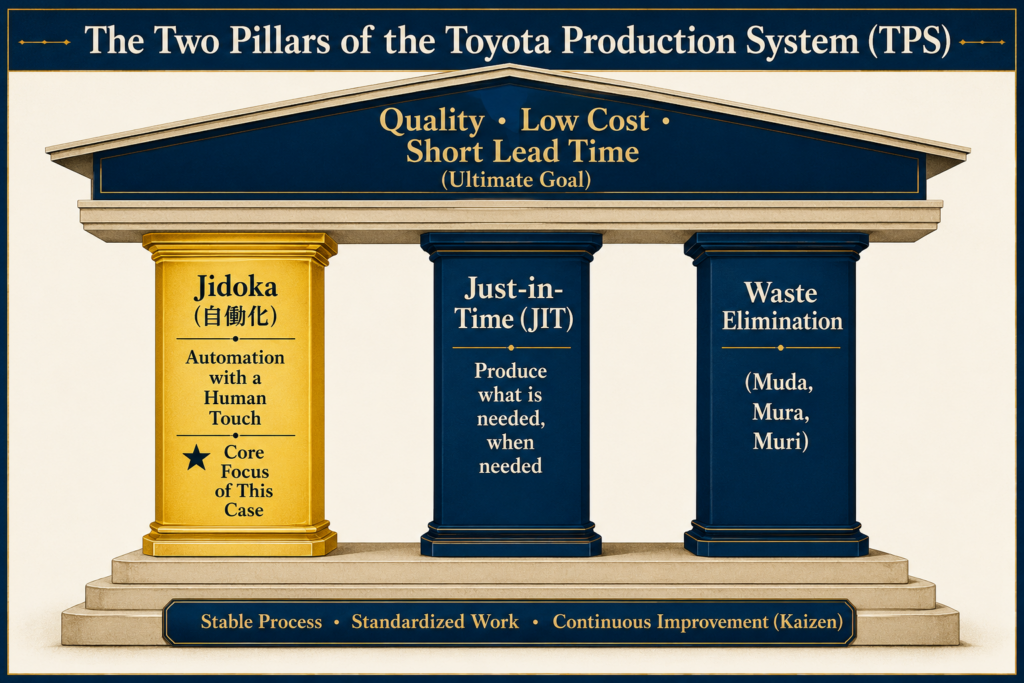
Figure 1: The Two Pillars of the Toyota Production System (TPS)
In figure 1, this diagram uses an architectural metaphor to illustrate the three core pillars of TPS: “Jidoka,” “Just-in-Time (JIT),” and “Waste Elimination.” The top-level goal is “Quality ・ Low Cost ・ Short Lead Time.” The “Jidoka” pillar is highlighted in gold to indicate it is the core analytical focus of this case study.
Analysis: A Righteous Advisory Perspective (RSS Framework)
Through the lens of the RSS Seven-Layer Framework, Toyota’s TPS provides a masterclass in embedding principles into operational processes:
RSS Layer 5: Process — Standardized Processes Ensure Righteous Outcomes
Toyota’s Andon system is a perfect example of a standardized process. It is not a casual suggestion but a rigorously enforced procedural safeguard. Every employee is given clear authority and responsibility to initiate the stop protocol when an anomaly is detected. This standardization ensures that “quality” is not an abstract goal but a systematically and reproducibly produced outcome.
Key Insight: Righteousness (in this case, manifested as “quality”) is not achieved through luck or individual heroism, but through repeatable, scalable standardized processes. When processes are correctly designed, righteousness becomes the natural output of daily organizational operations.
RSS Layer 2: Foundation — Respect for Workers as a Core Value
Behind the Andon system lies a fundamental respect for workers—the belief that workers are capable of identifying problems and worthy of being empowered to stop the production line. This respect is not a slogan but is embedded in every detail of the operational process.
Key Insight: The foundation of righteousness is respect for people. When an organization trusts its members’ judgment and empowers them to act, righteousness transforms from “a requirement from the top” into “a practice at the grassroots.”
Pillar: Integrity — Alignment of Values and Actions
Toyota publicly declares, “Quality is our priority.” By empowering workers to stop the line, the company aligns its capital expenditure (lost production) with its stated values (defect-free vehicles). There is no gap between the slogan and the salary. As the Lean Enterprise Institute notes, Jidoka “captures the principle of building quality into the production process—of designing work so that the people making the product have the means and mindset to be constantly vigilant for what is okay and what is not” (Ehrenfeld, 2016).
Pillar: Right Judgment — Discerning Long-term Value
The leadership exercised superior discernment by rejecting the myopic view of profitability (maximizing quarterly output). They correctly calculated that trust is a depreciating asset—once lost to a major recall, it cannot be quickly repurchased with marketing spend. Toyota’s success is a case study in long-term strategic discipline (ICERTIAS Journal, 2025).
This table 3 provides a comprehensive mapping of how each of the seven RSS layers corresponds to a specific element in the Toyota case study. The “Core Focus” and “Supporting” indicators show the relative emphasis of each layer in this analysis.
Table 3: RSS Seven-Layer Framework — Complete Mapping to Toyota
| RSS Layer | Layer Definition | Toyota Case Application | Emphasis |
|---|---|---|---|
| Layer 1: Fundamentals | Universal principles of righteousness (honesty, respect, responsibility, fairness) | Basic realities of manufacturing: Production lines assemble parts; quality defects lead to product failure; consumers expect safe, reliable vehicles. These are the unchanging premises Toyota must work within. | Background |
| Layer 2: Foundation | Core values and beliefs guiding righteous action; what the organization “believes in” | Respect for workers: Toyota believes workers can identify problems and deserve the authority to stop the production line. This is not a slogan but is embedded in every operational detail. | ⭐ Supporting |
| Layer 3: Alignment | Aligning resources, incentives, and behaviors with core values; ensuring “what we say, do, and reward” are consistent | Quality prioritized over output: Toyota declares “quality is our priority” and proves it by accepting line-stoppage losses. Capital expenditure (lost production) aligns with stated values (zero defects). | Supporting |
| Layer 4: Structure | Clear roles, responsibilities, and organizational architecture supporting righteousness | Andon system organizational architecture: Every workstation has an Andon cord; supervisors and engineers have clear responsibilities to respond; workers have clear authority to stop. No ambiguity. | Supporting |
| Layer 5: Process | Standardized processes that produce righteous outcomes; turning values into repeatable daily operations | Andon stop standard procedure: A four-stage standardized process (detect → pull → diagnose → resolve). Not a suggestion but a rigorously enforced procedural safeguard ensuring “quality” is systematically and reproducibly produced. | ⭐⭐⭐ Core Focus |
| Layer 6: Assurance | Evaluation, verification, and validation mechanisms confirming righteousness is being practiced | Zero-defect output and reliability premium: Toyota’s market reputation (reliability premium) is external validation of its quality processes; low recall rates are quantitative indicators of system effectiveness. | Background |
| Layer 7: Restoration | Correction, recovery, and improvement when righteousness is broken; how to become stronger | Recall prevention and continuous improvement (Kaizen): The Andon system itself is a “real-time restoration” mechanism—defects are contained before they escape. Kaizen culture ensures every line stop is a learning opportunity, making the system stronger. | Supporting |
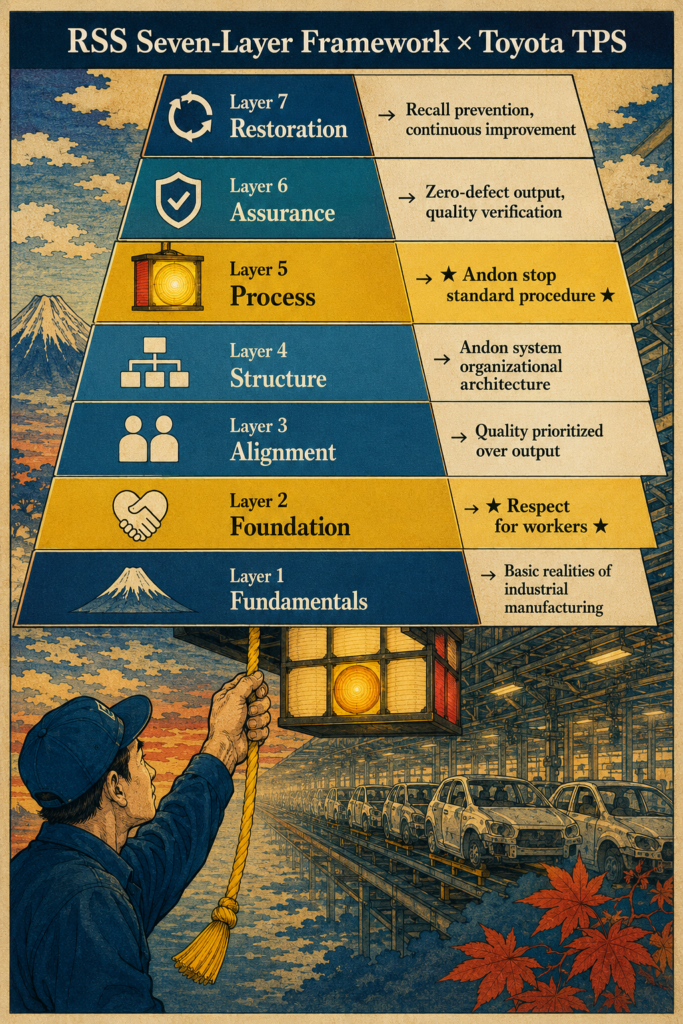
Figure 2: RSS Seven-Layer Framework Applied to Toyota
For Figure2, this vertical pyramid diagram maps each of the seven RSS layers to its corresponding element in the Toyota TPS case. Layer 2 (Foundation) corresponds to “Respect for Workers,” and Layer 5 (Process) corresponds to the “Andon Stop Standard Procedure.” These two layers are highlighted in gold to indicate they are the core analytical dimensions of this case study.
Lessons for the Executive Suite
The Toyota case offers three critical takeaways for modern leaders, particularly in knowledge-based industries where “defects” manifest as poor decisions rather than physical bolts:
1. Push Decision-Making to the Periphery
If you trust your frontline personnel only to execute, you blind your organization to early warnings. Trust them to stop. At Toyota, every single employee knows they have the power—and indeed the obligation—to stop the factory if they see something amiss (Businessworld, 2022).
2. Re-calibrate the Cost of “Stopping”
In your industry, what is the equivalent of the Andon cord? Is it a pause on a major project to re-evaluate data? Is it a budget hold to reassess compliance? Treat these “stops” as investments, not losses. As Spear (1999) observed, the TPS is a paradox—every activity is rigidly scripted, yet Toyota’s operations are designed as experiments that teach the scientific method to workers.
3. Transparency is a Hedge
Toyota’s reliability premium was not built by perfection, but by the honest handling of imperfection. In an era of instant scrutiny, hiding a defect is vastly more expensive than fixing it. Toyota has long been embraced for its robust, reliable vehicles—a reputation built on kaizen, continuous improvement, and giving workers the autonomy to stop the production line if a quality issue arises (paultan.org, 2025).
Discussion Questions for Boardrooms
- If your employees possessed the authority to “stop the line” in their daily workflows, would your current culture encourage them to do so, or penalize them?
- How does your firm calculate the “reliability premium” of your own brand? Is it actively managed at the operational level?
- What is the equivalent of the Andon cord in your industry—and have you empowered your people to pull it?
- Which of your organization’s current operational processes most urgently needs an “Andon-style” real-time stop mechanism?
References
Businessworld. (2022, September 28). The Andon cord was Toyota’s way of empowering the team. BW Businessworld.
Ehrenfeld, T. (2016, October 27). Lean roundup: Jidoka. Lean Enterprise Institute.
Global Legal Post. (2026, June 29). Toyota pays record $1.2b auto sector fine.
Harvard Business Review. (2016, April 1). The Toyota Production System works for relationships, too. HBR.
ICERTIAS Journal. (2025, March 20). Toyota’s success is a case study in long-term strategic discipline.
Ohno, T. (1995). Toyota production system: Beyond large-scale production. Productivity Press.
paultan.org. (2025, May 30). Toyota and kaizen – how continuous improvement forged a reputation for quality and reliability.
RNZ. (n.d.). Apology from Toyota boss. Radio New Zealand.
Spear, S. J. (1999, September–October). Decoding the DNA of the Toyota Production System. Harvard Business Review, 77(5), 96–106.
Toyota Motor Corporation. (n.d.-a). 75 years of Toyota | Part 2 Chapter 1 Section 4. Toyota-Global.com.
Toyota Motor Corporation. (n.d.-b). Toyota Production System | Vision & philosophy. Toyota-Global.com.
Toyota Motor UK. (2017, December 11). TMUK’s 25 Objects – 19: Andon Cord. Mag.Toyota.co.uk.
Wikipedia. (n.d.). Andon (manufacturing).
End of Case Study