

Version: v1.0
Last Updated: Q3 2026
Status: Active
“RI-OF: Benchmark the Field. Understand the Industry.”
The Righteous Index for Organization Field (RI-OF) is a standardized measurement tool designed to assess an organization’s collective state of righteousness within a specific industry or sector. Built upon the Righteous Standards System (RSS), RI-OF provides a field‑specific evaluation of organizational righteousness — enabling industry benchmarking, sector‑specific diagnostics, and comparative analysis. This document provides a comprehensive guide to RI-OF, including its 7 dimensions, field applications, questionnaire structure, scoring methodology, and practical applications for industry benchmarking and cross‑sector analysis. RI-OF shares the same 7 RSS layers, 25 measurement aspects, and consensus weights as RI-I, RI-OE, and RI-O. Field differentiation is achieved through question wording, assessment focus, and benchmarking context — not through changes to the core framework.
Table of Contents
| Section | Title |
|---|---|
| 1 | Overview of RI-OF |
| 1.1 | What Is RI-OF? |
| 1.2 | Purpose and Applications |
| 1.3 | Who Should Use RI-OF? |
| 2 | The 7 Dimensions of RI-OF |
| 2.1 | Dimension 1: Fundamentals |
| 2.2 | Dimension 2: Foundation |
| 2.3 | Dimension 3: Alignment |
| 2.4 | Dimension 4: Structure |
| 2.5 | Dimension 5: Process |
| 2.6 | Dimension 6: Assurance |
| 2.7 | Dimension 7: Restoration |
| 3 | RI-OF Field Applications |
| 3.1 | Finance (RI-OF-FIN) |
| 3.2 | Technology (RI-OF-TECH) |
| 3.3 | Healthcare (RI-OF-HEALTH) |
| 3.4 | Education (RI-OF-EDU) |
| 3.5 | Nonprofit (RI-OF-NPO) |
| 3.6 | Government (RI-OF-GOV) |
| 4 | RI-OF Questionnaire Structure |
| 4.1 | Question Format |
| 4.2 | Sample Questions by Dimension |
| 4.3 | RSS Measurement Aspects for RI-OF |
| 5 | RI-OF Scoring Methodology |
| 5.1 | Scoring Overview |
| 5.2 | Dimension Weighting |
| 5.3 | Score Calculation |
| 5.4 | Score Interpretation |
| 6 | Using RI-OF for Industry Benchmarking |
| 6.1 | Industry Benchmarking Process |
| 6.2 | Field‑Specific Customization Examples |
| 7 | RI-OF in the Broader Ecosystem |
| 7.1 | Relationship to RSS |
| 7.2 | Relationship to RI-O |
| 7.3 | Relationship to RMF and RGS |
| 8 | Frequently Asked Questions |
| Appendix | Reference Tables |
| A | RI-OF Dimension Summary |
| B | RI-OF Sample Report |
| C | RI-OF Version History |
| References |
1. Overview of RI-OF
1.1 What Is RI-OF?
RI-OF (Righteous Index for Organization Field) is a standardized measurement tool designed to assess an organization’s collective state of righteousness within a specific industry or sector. It is directly based on the Righteous Standards System (RSS) , which defines righteousness through 7 interdependent layers.
RI-OF provides a field‑specific evaluation of organizational righteousness, enabling:
- Industry Benchmarking — Compare your organization against industry peers
- Sector‑Specific Diagnostics — Identify field‑specific strengths and gaps
- Cross‑Sector Analysis — Compare performance across different industries
RI-OF shares the same core architecture as RI-O, but with:
- Question Wording tailored to specific fields
- Assessment Focus adjusted to reflect field‑specific challenges
- Benchmarking Context grounded in industry data and norms
RI-OF answers the question: “How righteous is our organization compared to others in our field?”
RI-OF does not add new factors or change weights for different fields. Field differentiation is achieved through question wording, assessment focus, and benchmarking context — not through changes to the core framework.
1.2 Purpose and Applications
RI-OF serves multiple purposes for organizations seeking to benchmark and grow in righteousness within their field:
Description: This table outlines the primary applications of RI-OF for organizations.
Table 1: RI-OF Purpose and Applications
| Application | Description |
|---|---|
| Industry Benchmarking | Compare organizational righteousness against industry peers and best practices |
| Sector‑Specific Diagnostics | Identify field‑specific strengths, gaps, and opportunities |
| Competitive Analysis | Understand how your organization’s righteousness compares to competitors |
| Strategic Planning | Inform strategic decisions with field‑specific righteousness data |
| Cross‑Sector Analysis | Compare performance across different industries or sectors |
| ESG / CSR Reporting | Provide field‑specific data for social and ethical performance reporting |
1.3 Who Should Use RI-OF?
RI-OF is designed for:
Table 2: RI-OF Target Users
Description: This table identifies the primary users of RI-OF and how they benefit from it.
| User Type | How They Use RI-OF |
|---|---|
| CEOs & Executives | Understand organizational righteousness relative to industry peers |
| HR Professionals | Support field‑specific culture transformation and benchmarking |
| Board Members | Oversee organizational culture and ethical performance relative to industry norms |
| Industry Associations | Conduct sector‑wide righteousness assessments and benchmarking |
| Organizational Development Consultants | Diagnose field‑specific cultural gaps and design interventions |
| Investors & Analysts | Evaluate organizational righteousness as part of investment analysis |
2. The 7 Dimensions of RI-OF
RI-OF is built on the Righteous Standards System (RSS) , which defines righteousness through 7 interdependent layers. Each layer corresponds to a dimension of RI-OF.
2.1 Dimension 1: Fundamentals
Corresponds to RSS Layer 1: Fundamentals
This dimension measures the organization’s commitment to universal principles of honesty, respect, fairness, and responsibility within its field.
Table 3: Fundamentals — What It Measures
Description: This table breaks down the key aspects of the Fundamentals dimension at the field‑specific level.
| Aspect | What It Measures |
|---|---|
| Values Clarity | How clearly the organization’s values are defined and communicated within its field |
| Integrity | How consistently the organization’s actions align with its stated values in field‑specific contexts |
| Dignity | How the organization values all stakeholders within its field |
| Authenticity | How true the organization is to its mission and purpose within its field |
2.2 Dimension 2: Foundation
Corresponds to RSS Layer 2: Foundation
This dimension measures the depth of the organization’s core values and beliefs that guide righteous action within its field.
Table 4: Foundation — What It Measures
Description: This table breaks down the key aspects of the Foundation dimension at the field‑specific level.
| Aspect | What It Measures |
|---|---|
| Groundedness | How stable and rooted the organization is in its values within its field |
| Leadership Commitment | How committed leaders are to upholding core values within the field |
| Consistency | How consistently values are applied across field‑specific contexts |
2.3 Dimension 3: Alignment
Corresponds to RSS Layer 3: Alignment
This dimension measures the consistency between the organization’s values, actions, and stakeholder relationships within its field.
Table 5: Alignment — What It Measures
Description: This table breaks down the key aspects of the Alignment dimension at the field‑specific level.
| Aspect | What It Measures |
|---|---|
| Trustworthiness | How reliably the organization follows through on commitments within its field |
| Respect | How the organization treats all stakeholders with dignity and fairness within its field |
| Connection | How deeply the organization connects with its stakeholders within its field |
| Belonging | How much employees feel part of a meaningful organizational community within its field |
2.4 Dimension 4: Structure
Corresponds to RSS Layer 4: Structure
This dimension measures the organization’s sense of purpose, contribution, and achievement within its field.
Table 6: Structure — What It Measures
Description: This table breaks down the key aspects of the Structure dimension at the field‑specific level.
| Aspect | What It Measures |
|---|---|
| Purpose | How clearly the organization’s purpose is defined and understood within its field |
| Contribution | How much the organization feels it is making a difference within its field |
| Achievement | How proud the organization is of what it accomplishes within its field |
| Progress | How much the organization sees itself growing within its field |
2.5 Dimension 5: Process
Corresponds to RSS Layer 5: Process
This dimension measures the organization’s ability to persevere, learn, and grow through challenges within its field.
Table 7: Process — What It Measures
Description: This table breaks down the key aspects of the Process dimension at the field‑specific level.
| Aspect | What It Measures |
|---|---|
| Resilience | How quickly the organization bounces back from field‑specific setbacks |
| Learning | How well the organization learns from field‑specific mistakes |
| Adaptability | How flexibly the organization responds to field‑specific changes |
| Perseverance | How consistently the organization persists through field‑specific difficulty |
2.6 Dimension 6: Assurance
Corresponds to RSS Layer 6: Assurance
This dimension measures the organization’s willingness to stand firm and act with integrity under pressure within its field.
Table 8: Assurance — What It Measures
Description: This table breaks down the key aspects of the Assurance dimension at the field‑specific level.
| Aspect | What It Measures |
|---|---|
| Moral Courage | How willing the organization is to do what is right within its field, even when it costs |
| Honesty | How truthful the organization is with all stakeholders within its field |
| Speaking Up | How readily employees speak up when they see something wrong within the field |
| Accountability | How the organization takes responsibility for its actions within its field |
2.7 Dimension 7: Restoration
Corresponds to RSS Layer 7: Restoration
This dimension measures the organization’s ability to recover, learn, and improve from failures within its field.
Table 9: Restoration — What It Measures
Description: This table breaks down the key aspects of the Restoration dimension at the field‑specific level.
| Aspect | What It Measures |
|---|---|
| Recovery | How quickly the organization recovers from field‑specific setbacks |
| Learning from Failure | How well the organization learns from field‑specific mistakes |
| Restoration | How the organization restores trust and relationships after field‑specific failures |
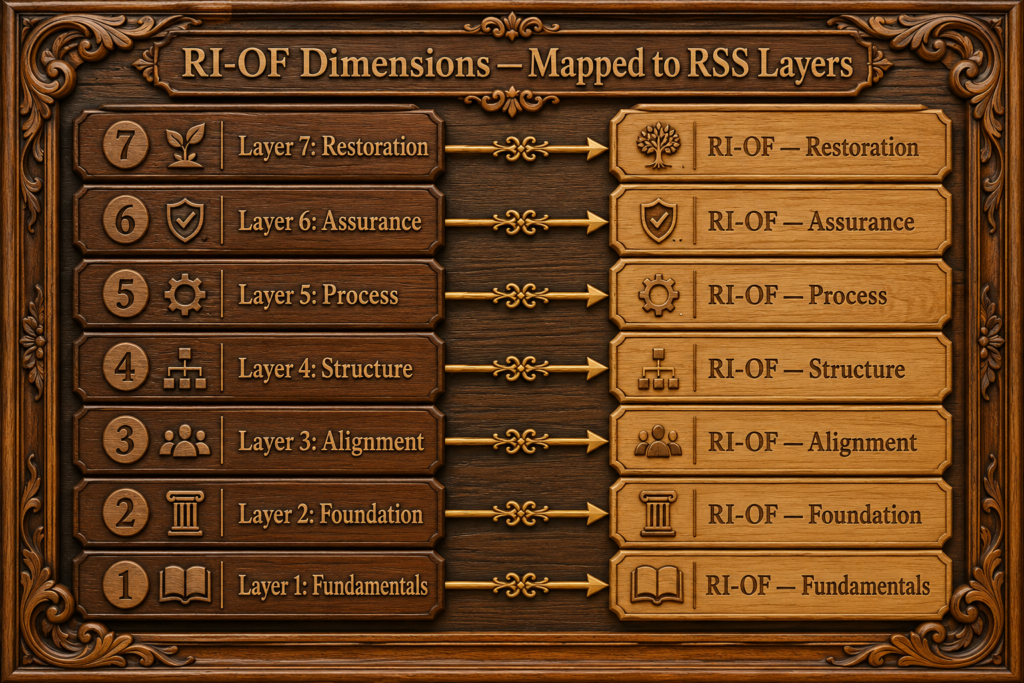
Figure 1: RI-OF 7 Dimensions — Mapped to RSS Layers
Figure 1 displays the 7 dimensions of RI-OF, each mapped to a corresponding RSS layer. The length of each bar represents the dimension’s consensus weight, showing the relative importance of each dimension in calculating the overall RI-OF score. Fundamentals has the highest weight (21%), while Assurance and Restoration share the lowest weights (8%).
3. RI-OF Field Applications
RI-OF is available in six core field versions, each customized for a specific industry or sector. All versions share the same 7 dimensions, 25 measurement aspects, and consensus weights — field differentiation is achieved through question wording, assessment focus, and benchmarking context.
Table 10: RI-OF Field Applications — Industry Versions
Description: This table lists all RI-OF industry versions and their customization focus areas.
| Field Version | Full Name | Customization Focus |
|---|---|---|
| RI-OF-FIN | Righteous Index for Organization Field — Finance | Integrity, compliance, client trust, risk management |
| RI-OF-TECH | Righteous Index for Organization Field — Technology | Data ethics, algorithmic fairness, privacy, accountability |
| RI-OF-HEALTH | Righteous Index for Organization Field — Healthcare | Patient safety, medical ethics, equitable care, quality |
| RI-OF-EDU | Righteous Index for Organization Field — Education | Academic integrity, educational equity, character development |
| RI-OF-NPO | Righteous Index for Organization Field — Nonprofit | Mission fidelity, funding transparency, beneficiary welfare |
| RI-OF-GOV | Righteous Index for Organization Field — Government | Public trust, integrity, impartial service, accountability |
3.1 Finance (RI-OF-FIN)
Target Organizations: Banks, insurance companies, investment firms, securities firms
Customization Focus:
- Client trust and transparency
- Regulatory compliance and ethical governance
- Risk management and responsible investment
- Integrity in financial reporting and disclosures
3.2 Technology (RI-OF-TECH)
Target Organizations: Software companies, hardware manufacturers, internet platforms
Customization Focus:
- Data privacy and protection
- Algorithmic fairness and accountability
- Responsible AI and technology ethics
- User trust and platform transparency
3.3 Healthcare (RI-OF-HEALTH)
Target Organizations: Hospitals, pharmaceutical companies, medical device manufacturers
Customization Focus:
- Patient safety and quality of care
- Medical ethics and professional integrity
- Equitable access to healthcare
- Transparency in clinical research and reporting
3.4 Education (RI-OF-EDU)
Target Organizations: Schools, universities, training institutes, educational non‑profits
Customization Focus:
- Academic integrity and honesty
- Educational equity and access
- Teacher‑student relationships and character development
- Institutional transparency and accountability
3.5 Nonprofit (RI-OF-NPO)
Target Organizations: Charities, foundations, social enterprises, humanitarian organizations
Customization Focus:
- Mission fidelity and impact
- Funding transparency and donor trust
- Beneficiary welfare and dignity
- Governance and board accountability
3.6 Government (RI-OF-GOV)
Target Organizations: Government departments, public agencies, regulatory bodies
Customization Focus:
- Public trust and institutional integrity
- Impartial service and fair administration
- Transparency and accountability in governance
- Ethical leadership and public sector ethics
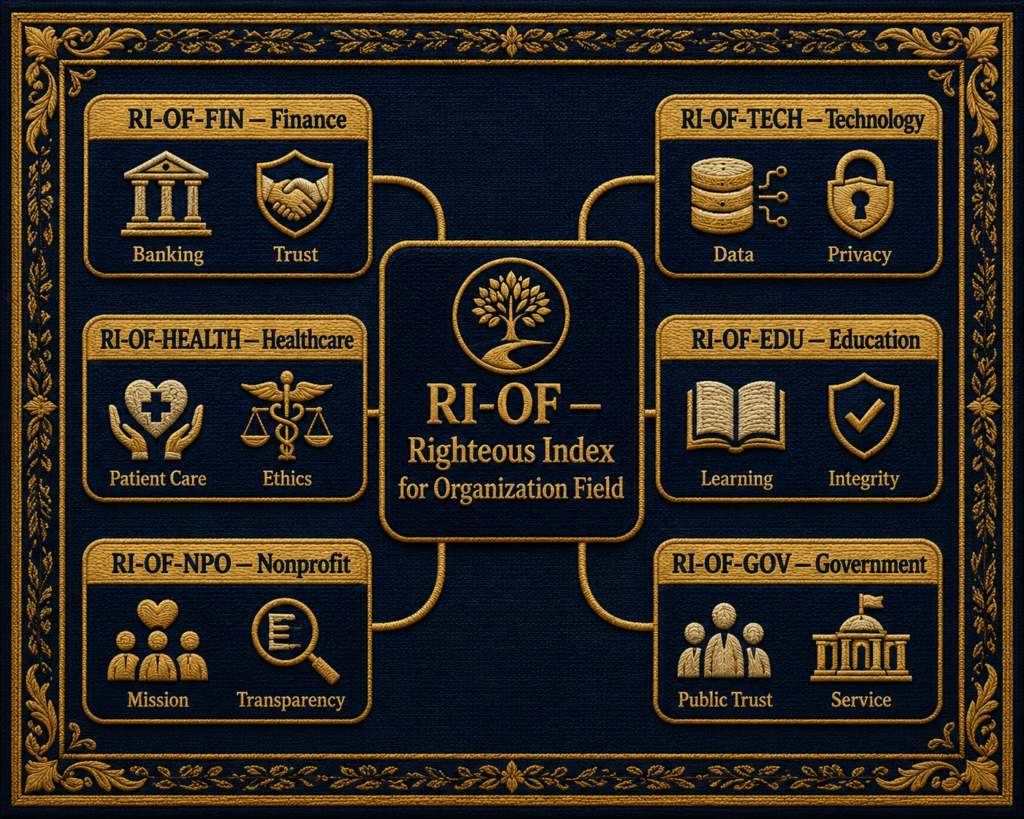
Figure 2: RI-OF Field Applications — Industry Versions
Description: This diagram shows the six RI-OF industry versions branching from the core RI-OF framework, illustrating the field‑specific customization areas for each sector.
4. RI-OF Questionnaire Structure
4.1 Question Format
RI-OF uses a 5‑point Likert scale for each question, consistent across all field versions.
Table 11: RI-OF Response Scale
Description: This table defines the 5‑point Likert scale used in the RI-OF questionnaire.
| Score | Label | Meaning |
|---|---|---|
| 5 | Strongly Agree | Consistently true in my experience |
| 4 | Agree | Mostly true in my experience |
| 3 | Neutral | Neither true nor false in my experience |
| 2 | Disagree | Mostly false in my experience |
| 1 | Strongly Disagree | Consistently false in my experience |
4.2 Sample Questions by Dimension
Table 12: RI-OF Sample Questions
Description: This table provides example questions for each of the 7 RI-OF dimensions, with field‑specific variations.
| Dimension | RI-OF-FIN (Finance) | RI-OF-TECH (Technology) | RI-OF-HEALTH (Healthcare) |
|---|---|---|---|
| Fundamentals | Our organization stays true to ethical financial practices even under pressure. | Our organization is honest about data usage and privacy. | Our organization prioritizes patient safety above all else. |
| Foundation | Our leaders are committed to ethical financial governance. | Our leaders are committed to responsible technology development. | Our leaders are committed to medical ethics and patient dignity. |
| Alignment | Our organization follows through on commitments to clients and investors. | Our organization follows through on commitments to user privacy. | Our organization follows through on commitments to patient care. |
| Structure | Our organization’s purpose includes serving the financial well‑being of our clients. | Our organization’s purpose includes serving the public good through technology. | Our organization’s purpose includes improving health outcomes. |
| Process | Our organization adapts well to regulatory and market changes. | Our organization adapts well to rapid technological change. | Our organization adapts well to medical advancements and regulations. |
| Assurance | Our organization speaks up about unethical financial practices. | Our organization speaks up about unethical data or AI practices. | Our organization speaks up about patient safety concerns. |
| Restoration | Our organization recovers from regulatory failures and restores trust. | Our organization recovers from data breaches and restores user trust. | Our organization recovers from medical errors and restores patient trust. |
4.3 RSS Measurement Aspects for RI-OF
RI-OF questionnaire is designed based on the 7 layers of the Righteous Standards System (RSS) .
Table 13: RSS Measurement Aspects by RI-OF Dimension
Description: This table shows how each RSS layer maps to an RI-OF dimension and the corresponding measurement aspects used for questionnaire design.
| RSS Layer | RI-OF Dimension | Measurement Aspects |
|---|---|---|
| Layer 1: Fundamentals | Fundamentals | Values Clarity, Integrity, Dignity, Authenticity |
| Layer 2: Foundation | Foundation | Groundedness, Leadership Commitment, Consistency |
| Layer 3: Alignment | Alignment | Trustworthiness, Respect, Connection, Belonging |
| Layer 4: Structure | Structure | Purpose, Contribution, Achievement, Progress |
| Layer 5: Process | Process | Resilience, Learning, Adaptability, Perseverance |
| Layer 6: Assurance | Assurance | Moral Courage, Honesty, Speaking Up, Accountability |
| Layer 7: Restoration | Restoration | Recovery, Learning from Failure, Restoration |
Note: These measurement aspects are identical to RI‑I, RI‑OE, and RI‑O. Field differentiation is achieved through question wording, not through changes to the measurement aspects themselves.
5. RI-OF Scoring Methodology
5.1 Scoring Overview
RI-OF uses a weighted scoring methodology to calculate a single overall score (0–100) that reflects the organization’s collective state of righteousness within its field.
Table 14: RI-OF Scoring Overview
Description: This table summarizes the key components of RI-OF scoring.
| Component | Description |
|---|---|
| Data Source | Aggregated RI-OF assessment data + field‑specific diagnostics |
| Core Dimensions | 7 dimensions (mapped to RSS layers) |
| Score Range | 0 – 100 |
| Calculation | Weighted sum of dimension scores |
| Field Customization | Question wording only — weights and dimensions remain consistent |
| Version Control | Semantic versioning (v1.0, v2.0, etc.) |
5.2 Dimension Weighting
Table 15: RI-OF Dimension Weights (v1.0)
Description: This table shows the consensus weights for each of the 7 RI-OF dimensions. RI-OF uses the same dimension weights as RI-I, RI-OE, and RI-O. These weights were established through a consensus process involving multiple expert sources, including the Righteous Advisory founding team, ChatGPT, Gemini, and Copilot. The final consensus weights were reviewed and approved by the Righteous Advisory team to ensure alignment with the RSS framework.
| Dimension | Weight | Rationale |
|---|---|---|
| Fundamentals | 21% | The foundation of all organizational righteousness — commitment to universal principles anchors every other dimension |
| Foundation | 20% | Core values and beliefs that guide all righteous action |
| Alignment | 18% | Consistency between values, actions, and stakeholder relationships — integrity in motion |
| Structure | 14% | Purpose, contribution, and achievement — the architectural framework for righteous action |
| Process | 11% | Resilience, learning, adaptability, and perseverance — sustaining righteousness through challenges |
| Assurance | 8% | Moral courage, honesty, speaking up, and accountability — the “stress‑test” dimension |
| Restoration | 8% | Recovery, learning from failure, and restoring relationships — episodic but essential for long‑term growth |
5.3 Score Calculation
Step 1: Calculate Dimension Raw Score (Field‑Specific Organization Level)
Aggregate all individual dimension scores and field‑specific diagnostic data to calculate the organizational average for each dimension.
Dimension Raw Score = Average of all responses for that dimension (field‑specific wording)Step 2: Calculate Dimension Weighted Score
Multiply the dimension raw score by its weight.
Dimension Weighted Score = Dimension Raw Score × Dimension WeightStep 3: Calculate Overall RI-OF Score
Sum all dimension weighted scores and convert to a 0–100 scale.
RI-OF Score = (Sum of all dimension weighted scores) × 205.4 Score Interpretation
Table 16: RI-OF Score Interpretation
Description: This table provides guidance on interpreting RI-OF scores, including recommended actions for each score range.
| Score Range | Rating | Description | Recommended Action |
|---|---|---|---|
| 86 – 100 | Exemplary | Organization consistently demonstrates righteousness within its field; a role model for others | Continue to maintain; consider sharing best practices with industry peers |
| 71 – 85 | Proficient | Solid foundation; demonstrates organizational righteousness consistently within its field | Identify specific areas for refinement |
| 51 – 70 | Developing | Foundational elements present; significant growth opportunities exist within the field | Prioritize 1–2 dimensions for focused organizational development |
| 0 – 50 | Emerging | Needs attention and development across multiple dimensions within the field | Begin with foundational dimensions (Fundamentals, Foundation) |
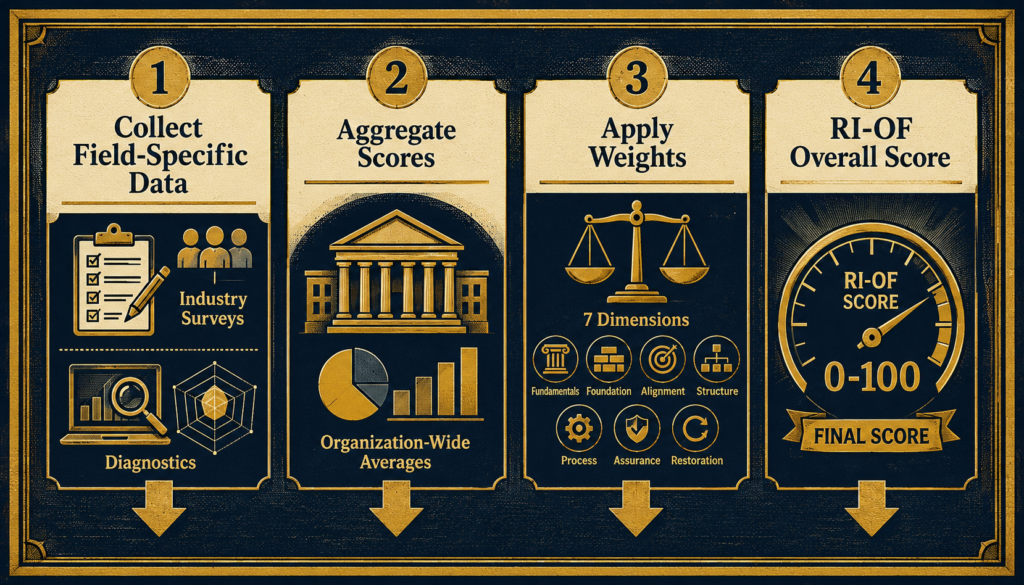
Figure 3: RI-OF Score Calculation Flow
This flowchart 3 illustrates the step‑by‑step process for calculating an organization’s RI-OF score from field‑specific data collection to the final 0‑100 score.
6. Using RI-OF for Industry Benchmarking
6.1 Industry Benchmarking Process
Table 17: RI-OF Industry Benchmarking Process
Description: This table outlines the step‑by‑step process for using RI-OF for industry benchmarking.
| Step | Action | Description |
|---|---|---|
| 1 | Select Field Version | Choose the appropriate RI-OF version for your industry (FIN, TECH, HEALTH, EDU, NPO, GOV) |
| 2 | Administer RI-OF Assessment | Collect field‑specific data from employees and organizational diagnostics |
| 3 | Receive Your RI-OF Report | Get your overall score and dimension scores in field‑specific context |
| 4 | Compare with Industry Benchmarks | Understand where your organization stands relative to industry peers |
| 5 | Identify Field‑Specific Priorities | Select 1–2 dimensions for focused field‑specific development |
| 6 | Create a Field‑Specific Development Plan | Develop goals and action steps tailored to your industry context |
| 7 | Track Your Progress | Re‑assess and compare against benchmarks over time |
6.2 Field‑Specific Customization Examples
Table 18: RI-OF Field‑Specific Customization Examples
Description: This table provides examples of how the same measurement aspect is adapted across different RI-OF field versions.
| Measurement Aspect | RI-OF-FIN (Finance) | RI-OF-TECH (Technology) | RI-OF-HEALTH (Healthcare) |
|---|---|---|---|
| Trustworthiness | Our organization follows through on commitments to clients and investors. | Our organization follows through on commitments to user privacy and data protection. | Our organization follows through on commitments to patient safety and quality care. |
| Integrity | Our organization maintains integrity in financial reporting and disclosures. | Our organization maintains integrity in algorithmic decision‑making. | Our organization maintains integrity in clinical research and reporting. |
| Accountability | Our organization takes responsibility for regulatory compliance. | Our organization takes responsibility for data and AI impacts. | Our organization takes responsibility for patient outcomes. |
| Learning from Failure | Our organization learns from regulatory failures and market mistakes. | Our organization learns from product failures and security incidents. | Our organization learns from medical errors and patient safety incidents. |
7. RI-OF in the Broader Ecosystem
7.1 Relationship to RSS
RI-OF is directly based on the Righteous Standards System (RSS) .
Table 19: RI-OF Dimensions Mapped to RSS Layers
Description: This table shows how each RI-OF dimension maps to an RSS layer.
| RSS Layer | RI-OF Dimension |
|---|---|
| Layer 1: Fundamentals | Fundamentals |
| Layer 2: Foundation | Foundation |
| Layer 3: Alignment | Alignment |
| Layer 4: Structure | Structure |
| Layer 5: Process | Process |
| Layer 6: Assurance | Assurance |
| Layer 7: Restoration | Restoration |
7.2 Relationship to RI-O
RI-OF is a field‑specific extension of RI-O.
Table 20: RI-O vs. RI-OF — Comparison
Description: This table compares RI-O and RI-OF across key dimensions.
| Aspect | RI-O | RI-OF |
|---|---|---|
| Scope | All organizations (general) | Specific industry/field |
| Question Wording | General organizational language | Field‑specific language |
| Assessment Focus | General organizational righteousness | Field‑specific challenges and norms |
| Benchmarking | Against own historical data | Against industry peers and best practices |
| Customization | Low (general) | High (field‑specific) |
| Dimensions | 7 RSS layers | 7 RSS layers (same) |
| Weights | 21/20/18/14/11/8/8 | 21/20/18/14/11/8/8 (same) |
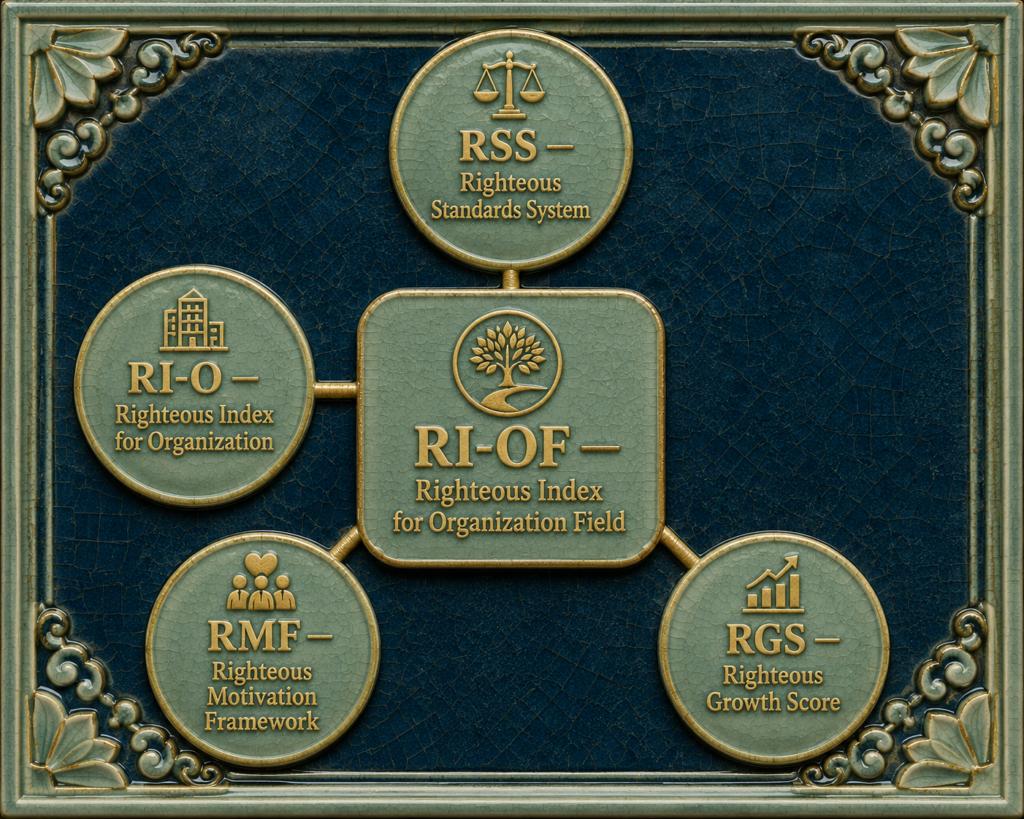
Figure 4: RI-OF in the Righteous Advisory Ecosystem
Description: This diagram shows RI-OF’s position in the Righteous Advisory ecosystem, connecting to RSS, RI-O, RMF, and RGS.
7.3 Relationship to RMF and RGS
Table 21: RI-OF in Relation to RMF and RGS
Description: This table shows how RI-OF works together with RMF and RGS to diagnose motivation gaps and track organizational growth within a field context.
| Tool | Role |
|---|---|
| RMF | Diagnoses motivation gaps that may explain low RI-OF scores in field‑specific contexts |
| RGS | Tracks RI-OF growth over time: RGS = RI-OF(T2) — RI-OF(T1) |
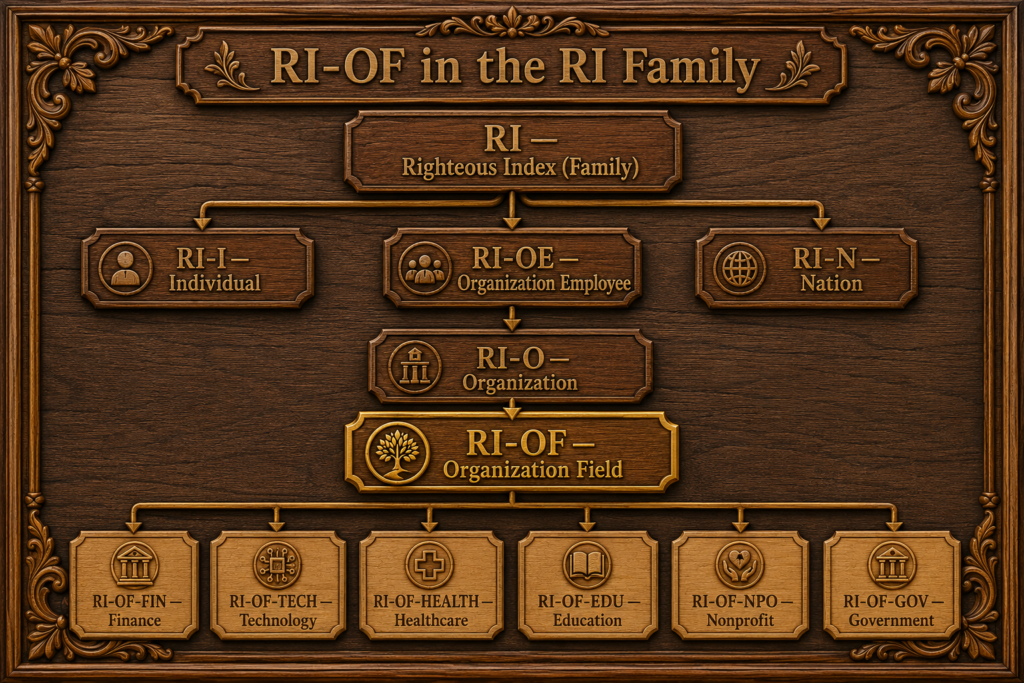
Figure 5: RI-OF in the RI Family
Description: This diagram shows RI-OF’s position within the RI family, illustrating its relationship to other RI versions and its role as a field‑specific extension of RI-O.
8. Frequently Asked Questions
Table 22: RI-OF Frequently Asked Questions
Description: This table provides answers to common questions about RI-OF.
| Question | Answer |
|---|---|
| How is RI-OF different from RI-O? | RI-O is general; RI-OF is field‑specific. Question wording is tailored to industry context. |
| Does RI-OF add new factors for different fields? | No. RI-OF uses the same 7 dimensions, 25 measurement aspects, and consensus weights as RI-O. Field differentiation is achieved through question wording and assessment focus. |
| How do I choose the right RI-OF version? | Select the version that matches your industry or sector (FIN, TECH, HEALTH, EDU, NPO, GOV). |
| Can I compare RI-OF scores across different fields? | Yes — because all versions share the same dimensions and weights, cross‑field comparison is possible. |
| How long does it take to complete RI-OF? | The assessment process typically takes 4–8 weeks depending on organization size and field complexity. |
| How often should we take RI-OF? | Recommended every 12–18 months to track field‑specific organizational growth. |
Appendix — Reference Tables
Table A: RI-OF Dimension Summary
Description: This table provides a quick reference for all 7 RI-OF dimensions.
| Dimension | Corresponding RSS Layer | Weight | Key Focus |
|---|---|---|---|
| Fundamentals | Layer 1 | 21% | Universal principles, values, integrity, authenticity |
| Foundation | Layer 2 | 20% | Core values, groundedness, leadership commitment, consistency |
| Alignment | Layer 3 | 18% | Trustworthiness, respect, connection, belonging |
| Structure | Layer 4 | 14% | Purpose, contribution, achievement, progress |
| Process | Layer 5 | 11% | Resilience, learning, adaptability, perseverance |
| Assurance | Layer 6 | 8% | Moral courage, honesty, speaking up, accountability |
| Restoration | Layer 7 | 8% | Recovery, learning from failure, restoration |
Table B: RI-OF Sample Report
Description: This table provides a sample RI-OF report showing scores across all 7 dimensions (using RI-OF-FIN as an example).
| Dimension | Score | Rating |
|---|---|---|
| Fundamentals | 82 | Proficient |
| Foundation | 75 | Proficient |
| Alignment | 65 | Developing |
| Structure | 88 | Exemplary |
| Process | 68 | Developing |
| Assurance | 72 | Proficient |
| Restoration | 70 | Developing |
Overall RI-OF Score: 74 — Proficient
Strengths: Structure (88), Fundamentals (82)
Growth Areas: Alignment (65), Process (68), Restoration (70)
Table C: RI-OF Version History
Description: This table documents the release history and key changes for RI-OF.
| Version | Release Date | Key Changes |
|---|---|---|
| v1.0 | Q3 2026 | Initial release with 6 core fields (FIN, TECH, HEALTH, EDU, NPO, GOV) |
| v1.1 | Q1 2027 | Refined field‑specific questions; improved weighting |
| v2.0 | Q4 2027 | Additional fields; enhanced predictive validity |
References
Deci, E. L., & Ryan, R. M. (2000). The “what” and “why” of goal pursuits: Human needs and the self-determination of behavior. Psychological Inquiry, 11(4), 227–268.
Likert, R. (1932). A technique for the measurement of attitudes. Archives of Psychology, 22(140), 1–55.
Nunnally, J. C., & Bernstein, I. H. (1994). Psychometric theory (3rd ed.). McGraw‑Hill.
Righteous Advisory. (2026). RSS Standard Catalog. https://advisory.wiserighteous.org/standard‑catalog/
Spear, S. J. (1999). Decoding the DNA of the Toyota Production System. Harvard Business Review, 77(5), 96–106.
Bottom Slogan: “RI-OF: Assess The Field. Know The Industry.”