
Version: v1.0
Last Updated: Q3 2026
Status: Active
RI-I: Know Your Number. Grow Your Righteousness.
Abstract
The Righteous Index for Individual (RI-I) is a standardized measurement tool designed to assess an individual’s current state of righteousness across 7 dimensions. Built upon the Righteous Standards System (RSS), RI-I provides a clear, objective picture of where an individual stands in their righteous journey — identifying strengths, uncovering growth areas, and enabling targeted personal development. This document provides a comprehensive guide to RI-I, including its 7 dimensions, questionnaire structure, scoring methodology, and practical applications for personal growth and coaching.
Table of Contents
| Section | Title |
|---|---|
| 1 | Overview of RI-I |
| 1.1 | What Is RI-I? |
| 1.2 | Purpose and Applications |
| 1.3 | Who Should Use RI-I? |
| 2 | The 7 Dimensions of RI-I |
| 2.1 | Dimension 1: Fundamentals |
| 2.2 | Dimension 2: Foundation |
| 2.3 | Dimension 3: Alignment |
| 2.4 | Dimension 4: Structure |
| 2.5 | Dimension 5: Process |
| 2.6 | Dimension 6: Assurance |
| 2.7 | Dimension 7: Restoration |
| 3 | RI-I Questionnaire Structure |
| 3.1 | Question Format |
| 3.2 | Sample Questions by Dimension |
| 3.3 | RSS Measurement Aspects for RI-I |
| 4 | RI-I Scoring Methodology |
| 4.1 | Scoring Overview |
| 4.2 | Dimension Weighting |
| 4.3 | Score Calculation |
| 4.4 | Score Interpretation |
| 5 | Using RI-I for Personal Growth |
| 5.1 | Self-Assessment Process |
| 5.2 | Creating a Growth Plan |
| 5.3 | Tracking Progress Over Time |
| 6 | RI-I in the Broader Ecosystem |
| 6.1 | Relationship to RSS |
| 6.2 | Relationship to RMF |
| 6.3 | Relationship to RGS |
| 7 | Frequently Asked Questions |
| Appendix | Reference Tables |
| A | RI-I Dimension Summary |
| B | RI-I Sample Report |
| C | RI-I Version History |
1. Overview of RI-I
1.1 What Is RI-I?
RI-I (Righteous Index for Individual) is a standardized measurement tool designed to assess an individual’s current state of righteousness across 7 dimensions. It is directly based on the Righteous Standards System (RSS) , which defines righteousness through 7 interdependent layers.
Much like a personal health checkup measures physical well-being, RI-I measures righteous health. It provides a clear, objective picture of where you stand across 7 key dimensions, helping you identify strengths and areas for growth.
RI-I is not a judgment — it is a starting point for growth.
1.2 Purpose and Applications
RI-I serves multiple purposes for individuals seeking to grow in righteousness:
Table 1: RI-I Purpose and Applications
| Application | Description |
|---|---|
| Self-Assessment | Understand your current state of righteousness across 7 dimensions |
| Personal Growth | Identify specific areas for development |
| Progress Tracking | Measure growth over time using RGS |
| Coaching & Mentoring | Provide a structured framework for development conversations |
| Leadership Development | Build self-awareness and intentional growth in integrity |
Description: This table outlines the primary applications of RI-I for individuals.
1.3 Who Should Use RI-I?
RI-I is designed for:
Table 2: RI-I Target Users
| User Type | How They Use RI-I |
|---|---|
| Individuals | Personal self-assessment and growth planning |
| Coaches & Mentors | Structured development conversations with clients |
| HR Professionals | Employee development and leadership programs |
| Leaders | Self-awareness and intentional growth in leadership |
| Anyone Seeking Growth | Anyone who wants to understand and grow in righteousness |
Description: This table identifies the primary users of RI-I and how they benefit from it.
2. The 7 Dimensions of RI-I
RI-I is built on the Righteous Standards System (RSS) , which defines righteousness through 7 interdependent layers. Each layer corresponds to a dimension of RI-I.
2.1 Dimension 1: Fundamentals
Corresponds to RSS Layer 1: Fundamentals
This dimension measures the strength of your foundation — your commitment to universal principles of honesty, respect, fairness, and responsibility.
Table 3: Fundamentals — What It Measures
| Aspect | What It Measures |
|---|---|
| Values Clarity | How clearly you know what you stand for |
| Integrity | How consistently your actions align with your stated values |
| Dignity | How you value yourself and others |
| Authenticity | How true you are to who you are |
Description: This table breaks down the key aspects of the Fundamentals dimension.
2.2 Dimension 2: Foundation
Corresponds to RSS Layer 2: Foundation
This dimension measures the depth of your core values and beliefs that guide righteous action.
Table 4: Foundation — What It Measures
| Aspect | What It Measures |
|---|---|
| Groundedness | How stable and rooted you are in your values |
| Self-Mastery | Your ability to discipline yourself and stay true to your convictions |
| Consistency | How consistently you apply your values across different situations |
Description: This table breaks down the key aspects of the Foundation dimension.
2.3 Dimension 3: Alignment
Corresponds to RSS Layer 3: Alignment
This dimension measures the consistency between your values, actions, and relationships.
Table 5: Alignment — What It Measures
| Aspect | What It Measures |
|---|---|
| Trustworthiness | How reliably you follow through on commitments |
| Respect | How you treat others with dignity and fairness |
| Connection | How deeply you connect with others |
| Belonging | How much you feel part of a meaningful community |
Description: This table breaks down the key aspects of the Alignment dimension.
2.4 Dimension 4: Structure
Corresponds to RSS Layer 4: Structure
This dimension measures your sense of purpose, contribution, and accomplishment.
Table 6: Structure — What It Measures
| Aspect | What It Measures |
|---|---|
| Purpose | How clearly you understand your “why” |
| Contribution | How much you feel you are making a difference |
| Achievement | How proud you are of what you accomplish |
| Progress | How much you see yourself growing |
Description: This table breaks down the key aspects of the Structure dimension.
2.5 Dimension 5: Process
Corresponds to RSS Layer 5: Process
This dimension measures your ability to persevere, learn, and grow through challenges.
Table 7: Process — What It Measures
| Aspect | What It Measures |
|---|---|
| Resilience | How quickly you bounce back from setbacks |
| Learning | How well you learn from mistakes |
| Adaptability | How flexibly you respond to change |
| Perseverance | How consistently you persist through difficulty |
Description: This table breaks down the key aspects of the Process dimension.
2.6 Dimension 6: Assurance
Corresponds to RSS Layer 6: Assurance
This dimension measures your willingness to stand firm and act with integrity under pressure.
Table 8: Assurance — What It Measures
| Aspect | What It Measures |
|---|---|
| Moral Courage | How willing you are to do what is right, even when it costs you |
| Honesty | How truthful you are with yourself and others |
| Speaking Up | How readily you speak up when you see something wrong |
| Accountability | How you take responsibility for your actions |
Description: This table breaks down the key aspects of the Assurance dimension.
2.7 Dimension 7: Restoration
Corresponds to RSS Layer 7: Restoration
This dimension measures your ability to recover, learn, and improve from failures.
Table 9: Restoration — What It Measures
| Aspect | What It Measures |
|---|---|
| Recovery | How quickly you recover from setbacks |
| Learning from Failure | How well you learn from mistakes |
| Restoration | How you restore yourself and others after failure |
Description: This table breaks down the key aspects of the Restoration dimension.
3. RI-I Questionnaire Structure
3.1 Question Format
RI-I uses a 5-point Likert scale for each question.
Table 10: RI-I Response Scale
| Score | Label | Meaning |
|---|---|---|
| 5 | Strongly Agree | Consistently true in my experience |
| 4 | Agree | Mostly true in my experience |
| 3 | Neutral | Neither true nor false in my experience |
| 2 | Disagree | Mostly false in my experience |
| 1 | Strongly Disagree | Consistently false in my experience |
Description: This table defines the 5-point Likert scale used in the RI-I questionnaire.
3.2 Sample Questions by Dimension
Table 11: RI-I Sample Questions
| Dimension | Sample Questions |
|---|---|
| Fundamentals | I stay true to my values even under pressure. I am honest even when it is difficult. I treat myself and others with dignity. I am authentic in how I present myself. |
| Foundation | I have a clear sense of what I stand for. I have the discipline to stay true to my convictions. I am consistent in how I apply my values. |
| Alignment | People trust me to follow through on my commitments. I treat others with respect and fairness. I feel a genuine sense of belonging in my community. |
| Structure | My work gives me a sense of purpose. I feel I am making a meaningful contribution. I am proud of what I accomplish. I see progress in my personal growth. |
| Process | I bounce back from setbacks quickly. I learn from my mistakes. I adapt well when circumstances change. I persist through challenges. |
| Assurance | I speak up when I see something wrong. I take responsibility for my actions. I act with integrity even when no one is watching. I hold myself accountable for my choices. |
| Restoration | I recover from failures and setbacks. I learn from my failures. I work to restore trust after mistakes. |
Description: This table provides example questions for each of the 7 RI-I dimensions.
3.3 RSS Measurement Aspects for RI-I
RI-I questionnaire is designed based on the 7 layers of the Righteous Standards System (RSS) . Each layer corresponds to a dimension of RI-I, and each dimension includes Measurement Aspects that serve as the direct source for questionnaire items.
Table 12: RSS Measurement Aspects by RI-I Dimension
| RSS Layer | RI-I Dimension | Measurement Aspects |
|---|---|---|
| Layer 1: Fundamentals | Fundamentals | Values Clarity, Integrity, Dignity, Authenticity |
| Layer 2: Foundation | Foundation | Groundedness, Self-Mastery, Consistency |
| Layer 3: Alignment | Alignment | Trustworthiness, Respect, Connection, Belonging |
| Layer 4: Structure | Structure | Purpose, Contribution, Achievement, Progress |
| Layer 5: Process | Process | Resilience, Learning, Adaptability, Perseverance |
| Layer 6: Assurance | Assurance | Moral Courage, Honesty, Speaking Up, Accountability |
| Layer 7: Restoration | Restoration | Recovery, Learning from Failure, Restoration |
Description: This table shows how each RSS layer maps to an RI-I dimension and the corresponding measurement aspects used for questionnaire design.
Note: These measurement aspects serve as the common foundation for all RI versions (RI-I, RI-OE, RI-O, RI-OF, RI-N). App developers and questionnaire designers can directly use these aspects to generate specific questions.
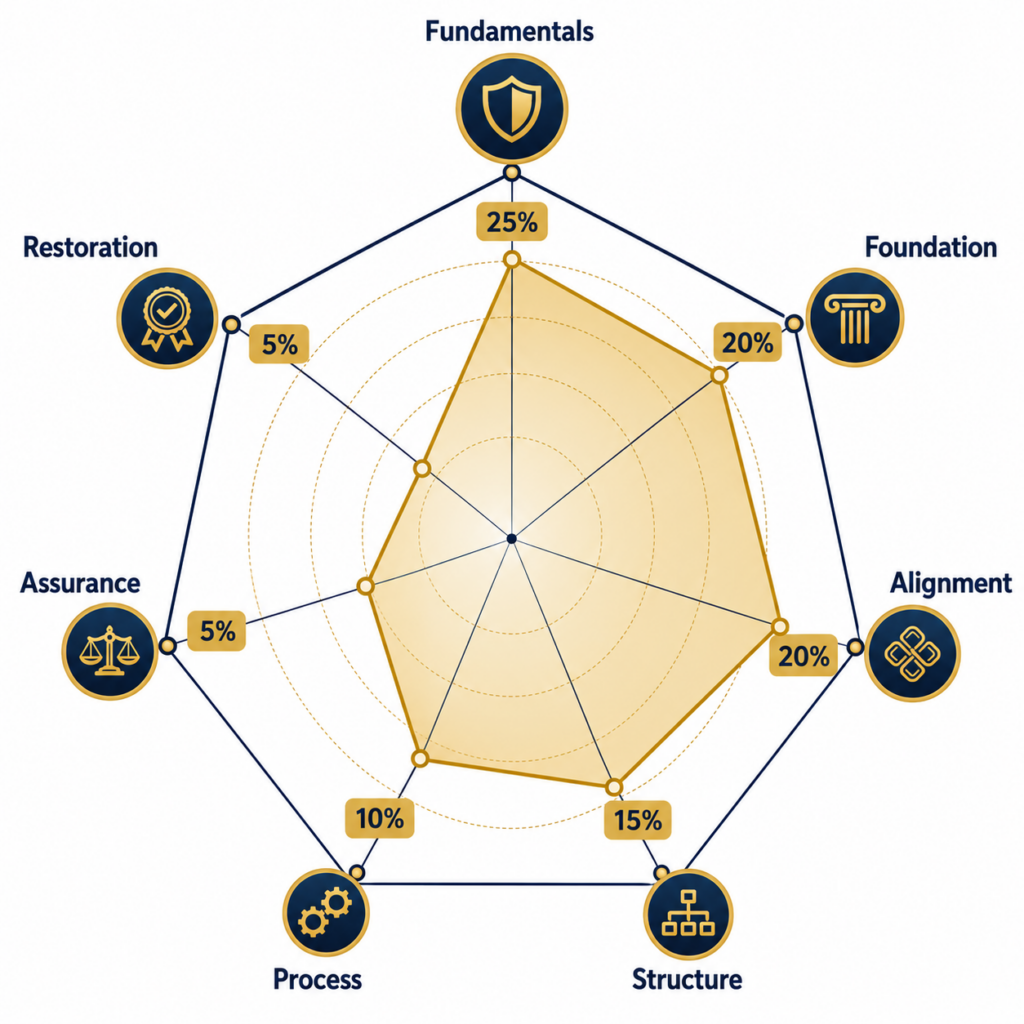
Figure 1: RI-I 7 Dimensions — Mapped to RSS Layers
4. RI-I Scoring Methodology
4.1 Scoring Overview
RI-I uses a weighted scoring methodology to calculate a single overall score (0–100) that reflects your current state of righteousness.
Table 13: RI-I Scoring Overview
| Component | Description |
|---|---|
| Data Source | RI-I questionnaire responses (5-point Likert scale) |
| Core Dimensions | 7 dimensions (mapped to RSS layers) |
| Score Range | 0 – 100 |
| Calculation | Weighted sum of dimension scores |
| Version Control | Semantic versioning (v1.0, v2.0, etc.) |
Description: This table summarizes the key components of RI-I scoring.
4.2 Dimension Weighting
Table 14: RI-I Dimension Weights (v1.0)
| Dimension | Weight | Rationale |
|---|---|---|
| Fundamentals | 21% | The foundation of all righteousness — commitment to universal principles (honesty, respect, fairness, responsibility) anchors every other dimension |
| Foundation | 20% | Core values and beliefs that guide all righteous action — the depth and stability of internal grounding |
| Alignment | 18% | Consistency between values, actions, and relationships — integrity in motion |
| Structure | 14% | Purpose, contribution, and achievement — the architectural framework for righteous action |
| Process | 11% | Resilience, learning, adaptability, and perseverance — sustaining righteousness through challenges |
| Assurance | 8% | Moral courage, honesty, speaking up, and accountability — the “stress‑test” dimension |
| Restoration | 8% | Recovery, learning from failure, and restoring relationships — episodic but essential for long‑term growth |
Description: This table shows the consensus weights for each of the 7 RI-I dimensions, derived from the average of multiple expert sources (ChatGPT, Gemini, Copilot, and internal baseline).
4.3 Score Calculation
Step 1: Calculate Dimension Raw Score
For each dimension, calculate the average score of all questions in that dimension.
Dimension Raw Score = (Sum of all question scores in that dimension) / (Number of questions)Step 2: Calculate Dimension Weighted Score
Multiply the dimension raw score by its weight.
Dimension Weighted Score = Dimension Raw Score × Dimension WeightStep 3: Calculate Overall RI-I Score
Sum all dimension weighted scores and convert to a 0–100 scale.
RI-I Score = (Sum of all dimension weighted scores) × 20Example:
| Dimension | Raw Score | Weight | Weighted Score |
|---|---|---|---|
| Fundamentals | 4.33 | 21% | 0.909 |
| Foundation | 3.80 | 20% | 0.760 |
| Alignment | 3.50 | 18% | 0.630 |
| Structure | 4.50 | 14% | 0.630 |
| Process | 3.20 | 11% | 0.352 |
| Assurance | 2.90 | 8% | 0.232 |
| Restoration | 3.10 | 8% | 0.248 |
| Total | 100% | 3.761 |
RI-I Score = 3.761 × 20 = 75.22 → 75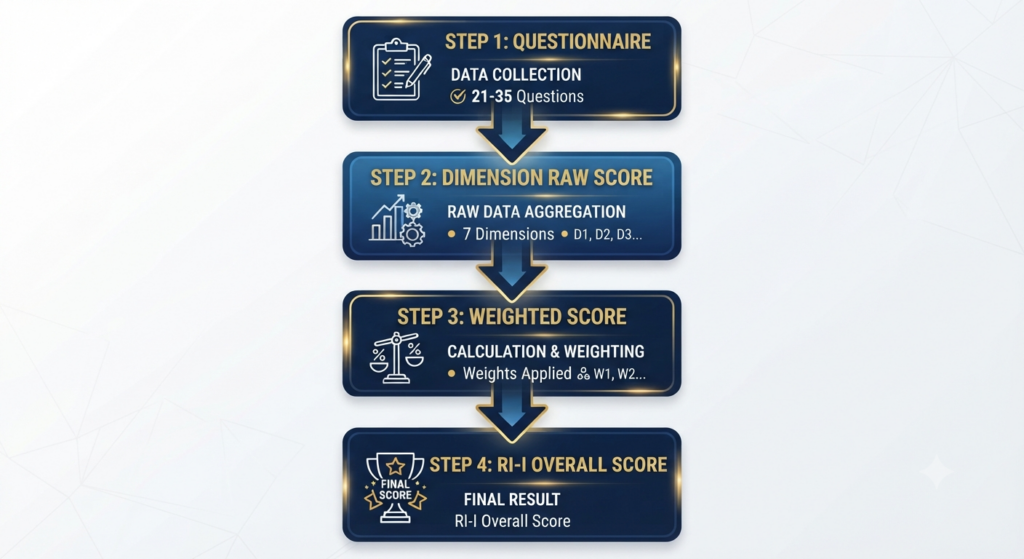
Figure 2: RI-I Score Calculation Flow
4.4 Score Interpretation
Table 15: RI-I Score Interpretation
| Score Range | Rating | Description | Recommended Action |
|---|---|---|---|
| 86 – 100 | Exemplary | Consistently demonstrates righteousness; a role model for others | Continue to maintain; consider mentoring others |
| 71 – 85 | Proficient | Solid foundation; demonstrates righteousness consistently | Identify specific areas for refinement |
| 51 – 70 | Developing | Foundational elements present; significant growth opportunities exist | Prioritize 1–2 dimensions for focused development |
| 0 – 50 | Emerging | Needs attention and development across multiple dimensions | Begin with foundational dimensions (Fundamentals, Foundation) |
Description: This table provides guidance on interpreting RI-I scores, including recommended actions for each score range.
5. Using RI-I for Personal Growth
5.1 Self-Assessment Process
Table 16: RI-I Self-Assessment Process
| Step | Action | Description |
|---|---|---|
| 1 | Complete the Questionnaire | Answer all 21–35 questions honestly |
| 2 | Receive Your RI-I Score | Get your overall score and dimension scores |
| 3 | Review Your Results | Understand your strengths and growth areas |
| 4 | Identify Priorities | Select 1–2 dimensions for focused development |
| 5 | Create a Growth Plan | Develop specific goals and action steps |
| 6 | Track Your Progress | Re-assess in 3–6 months using RGS |
Description: This table outlines the step-by-step process for completing the RI-I self-assessment.
5.2 Creating a Growth Plan
Table 17: RI-I Growth Plan Template — Sample
| Dimension | Score | Priority (Y/N) | Goal | Action Steps | Target Date |
|---|---|---|---|---|---|
| Fundamentals | 82 | N | Maintain this strength | Continue journaling on values; mentor others on integrity | Ongoing |
| Foundation | 75 | N | Build on existing foundation | Deepen self-reflection practices | 3 months |
| Alignment | 65 | Y | Improve consistency between words and actions | Practice speaking up more; seek feedback | 6 months |
| Structure | 88 | N | Sustain high purpose | Lead a purpose-driven project | 6 months |
| Process | 68 | Y | Build resilience | Read one book on resilience; learn from one setback per week | 3 months |
| Assurance | 72 | N | Maintain ethical courage | Continue to speak up when needed | Ongoing |
| Restoration | 70 | Y | Develop recovery habits | Create a personal recovery plan after setbacks | 6 months |
Description: This table provides a completed example of an RI-I growth plan using sample scores and goals.
5.3 Tracking Progress Over Time
Table 18: RI-I Progress Tracking
| Assessment Date | RI-I Score | Change | Note |
|---|---|---|---|
| Initial (T1) | 68 | — | Baseline |
| 3 Months (T2) | 72 | +4 | Small improvement |
| 6 Months (T3) | 78 | +6 | Continued growth |
| 12 Months (T4) | 82 | +4 | Maintained improvement |
Description: This table illustrates how RI-I scores can be tracked over time to measure growth.
6. RI-I in the Broader Ecosystem
6.1 Relationship to RSS
RI-I is directly based on the Righteous Standards System (RSS) .
Table 19: RI-I Dimensions Mapped to RSS Layers
| RSS Layer | RI-I Dimension |
|---|---|
| Layer 1: Fundamentals | Fundamentals |
| Layer 2: Foundation | Foundation |
| Layer 3: Alignment | Alignment |
| Layer 4: Structure | Structure |
| Layer 5: Process | Process |
| Layer 6: Assurance | Assurance |
| Layer 7: Restoration | Restoration |
Description: This table shows how each RI-I dimension maps to one or more RSS layers.
6.2 Relationship to RMF
RI-I provides the measurement foundation for RMF. RMF uses RI-I data as input for its diagnosis phase, identifying motivation gaps that require treatment.
Table 20: RI-I and RMF Workflow
| Phase | Tool | Action |
|---|---|---|
| Measurement | RI-I | Assess current state of righteousness |
| Diagnosis | RMF | Identify motivation gaps |
| Treatment | RMF | Provide education, rewards, and environmental changes |
| Prevention | RMF | Provide continuous reminders and regular re-assessment |
Description: This table shows the workflow from RI-I measurement to RMF intervention.
6.3 Relationship to RGS
RGS (Righteous Growth Score) tracks the change in RI-I over time.
Table 21: RGS Calculation
| Formula | Description |
|---|---|
| RGS = RI-I(T2) — RI-I(T1) | RGS measures whether an individual is growing in righteousness over time, providing a clear indicator of progress. |
Description: This table shows how RGS is calculated from RI-I scores.
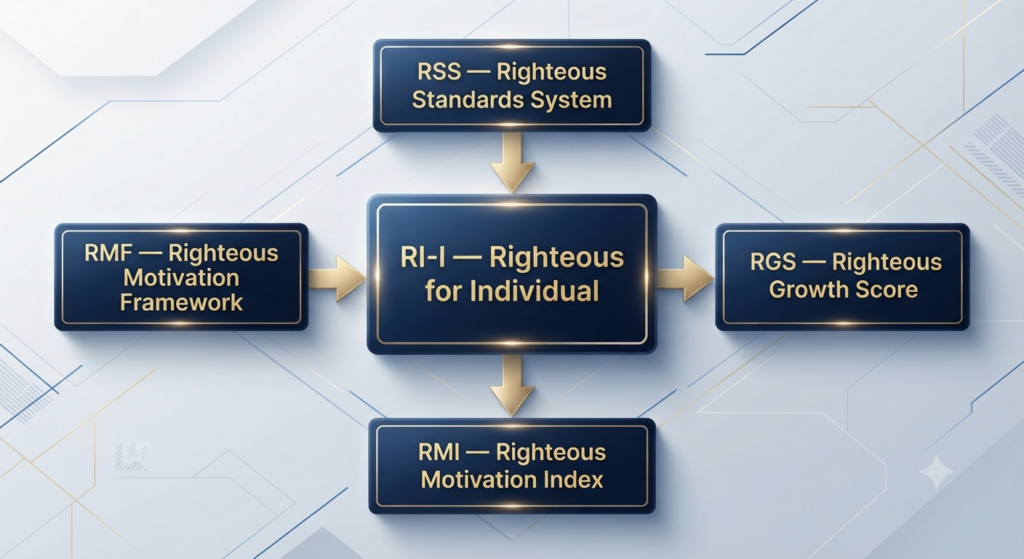
Figure 3: RI-I in the Righteous Advisory Ecosystem
7. Frequently Asked Questions
Table 22: RI-I Frequently Asked Questions
| Question | Answer |
|---|---|
| How long does it take to complete RI-I? | Approximately 15–20 minutes. |
| How often should I take RI-I? | Recommended every 3–6 months to track growth. |
| Can I use RI-I for coaching others? | Yes, RI-I is designed for coaches and mentors working with individuals. |
| What is the difference between RI-I and RMI-I? | RI-I measures current state of righteousness. RMI-I measures motivation to pursue righteousness. |
| Is RI-I confidential? | Yes, all responses are confidential and only shared with the individual (unless they choose to share with a coach/mentor). |
| Can I compare my score with others? | RI-I is designed for personal growth, not comparison. However, you can track your own progress over time using RGS. |
Description: This table provides answers to common questions about RI-I.
Appendix — Reference Tables
Table A: RI-I Dimension Summary
| Dimension | Corresponding RSS Layer | Weight | Key Focus |
|---|---|---|---|
| Fundamentals | Layer 1 | 21% | Universal principles, values, integrity, authenticity |
| Foundation | Layer 2 | 20% | Core values, groundedness, self-mastery, consistency |
| Alignment | Layer 3 | 18% | Trustworthiness, respect, connection, belonging |
| Structure | Layer 4 | 14% | Purpose, contribution, achievement, progress |
| Process | Layer 5 | 11% | Resilience, learning, adaptability, perseverance |
| Assurance | Layer 6 | 8% | Moral courage, honesty, speaking up, accountability |
| Restoration | Layer 7 | 8% | Recovery, learning from failure, restoration |
Description: This table provides a quick reference for all 7 RI-I dimensions.
Table B: RI-I Sample Report
| Dimension | Score | Rating |
|---|---|---|
| Fundamentals | 82 | Proficient |
| Foundation | 75 | Proficient |
| Alignment | 65 | Developing |
| Structure | 88 | Exemplary |
| Process | 68 | Developing |
| Assurance | 72 | Proficient |
| Restoration | 70 | Developing |
Overall RI-I Score: 74 — Proficient
Strengths: Structure (88), Fundamentals (82)
Growth Areas: Alignment (65), Process (68), Restoration (70)
Description: This table provides a sample RI-I report showing scores across all 7 dimensions.
Table C: RI-I Version History
| Version | Release Date | Key Changes |
|---|---|---|
| v0.5 | Q1 2026 | Initial release |
| v1.0 | Q3 2026 | Refined questions; improved weighting |
| v2.0 | Q1 2027 | New dimensions; enhanced predictive validity |
References
Deci, E. L., & Ryan, R. M. (2000). The “what” and “why” of goal pursuits: Human needs and the self-determination of behavior. Psychological Inquiry, 11(4), 227–268.
Likert, R. (1932). A technique for the measurement of attitudes. Archives of Psychology, 22(140), 1–55. Nunnally, J. C., & Bernstein, I. H. (1994). Psychometric theory (3rd ed.). McGraw-Hill.
Righteous Advisory. (2026). RSS Standard Catalog. https://advisory.wiserighteous.org/standard-catalog/
Spear, S. J. (1999). Decoding the DNA of the Toyota Production System. Harvard Business Review, 77(5), 96–106.
Righteous Index for Individual (RI-I): Your Righteous Compass.